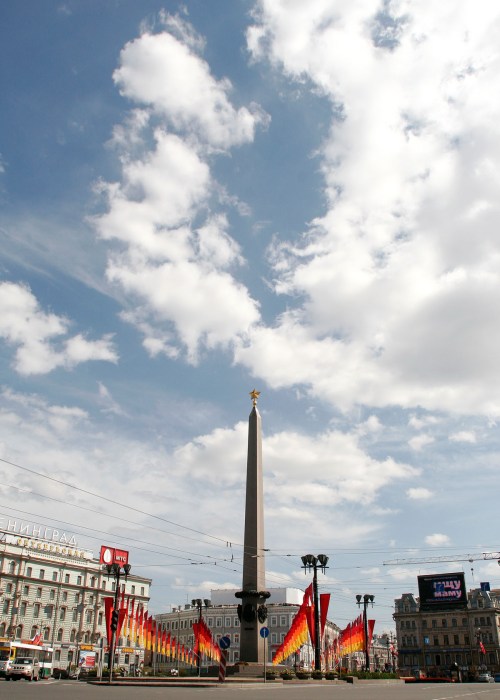
Tag Archives: St. Petersburg

The State Memorial Museum of the Defense and Blockade of Leningrad

A million Leningraders died during the 900 day siege of the city during the Second Great Patriotic War. Some starved, some froze, and some were killed by German guns and bombs.

The siege plays a heavy role in the city’s collective memory. I’ve already written about Victory Day, but beyond that single day, memorials to the dead and reminders of the city’s heroic sacrifice are everywhere. Incidentally, there was even one on the wall of the movie theater we went to after we left the State Memorial Museum of the Defense and Blockade of Leningrad.

The museum itself is contained in a plain building, across a canal from the flashier parts of Petersburg. The exhibits—old Soviet and Nazi German uniforms, maps, guns, photos, letters, and lots of other items—line the walls of a single large warehouse room. Massive paintings of battle scenes and Soviet leaders sit higher on the walls, above the exhibit cases, framed by large gray curtains.

I was amazed by the sheer concentration of World War II stuff in the museum, although I couldn’t read most of it. There were photos of the Soviet leaders I’ve read so much about, including a particularly cool one of Gen. Eisenhower and Georgy Zhukov, a Soviet Marshall who led the Red Army to Berlin.

There were also plenty of weapons, from AK machine guns to partisan bolt-action rifles—and even an anti-tank gun—and a bunch of bombs and mines. As for uniforms, there were some Soviet ones (from what I could tell, they had belonged to Heroes of the Soviet Union) filled with medals and ribbons, as well as some Nazi ones, including SS uniforms with lightning bolts and Totenkopf, or Death’s Head skulls.

Between the military paraphernalia, there was a reconstructed blockade-era apartment flanked by photos of people living day-to-day, looking just slightly healthier than concentration camp survivors. The only sound was the ticking of a metronome on the radio—the beating heart of Leningrad.

There was also propaganda… Lots and lots of propaganda. I gotta say, I loved it. I mean, who doesn’t love Nazi soldiers portrayed as either evil or incredibly stupid? The great thing about propaganda, too, is that it’s mostly visual. So while we couldn’t figure out most of the words, the meaning got through (It helps that the word for fascist is pretty much the same in Russian).

One that was particularly amusing involved three panels:

  1. Nazis reading a complicated list of orders.
  2. Nazis marching with a full band.
  3. Soviet soldiers popping up, surprising the Nazis, and wiping them out. (The caption was something along the lines of “Our orders are simple. Kill the fascist occupiers.”

We’re planning to go back and get an English-language tour of the museum at some point so that we actually understand what’s going on a bit more.

Tonight is Museum Night in St. Petersburg. 150 Rubles to get into a ton of museums around the city—and the museums are open from 6 p.m. to 6 a.m. There are buses running between the museums all night, but we need to be back on our island before the bridges go up around 1:30 a.m.

We’re planning on checking out the Peter and Paul Fortress, the Artillery Museum, where you can apparently climb on tanks and artillery and such, the Museum of the Political History of Russia (and the attached, and closely connected Museum of the History of the Political Police. Seriously.), and several others.

Also – Kirov’s apartment. The assassination of Sergey Kirov in 1934 (incidentally in the Smolny Institute, where we go to school every day) helped start Stalin’s purges.
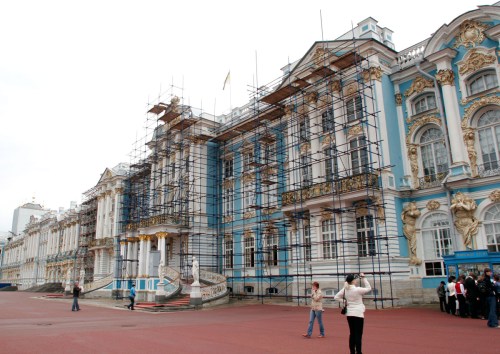
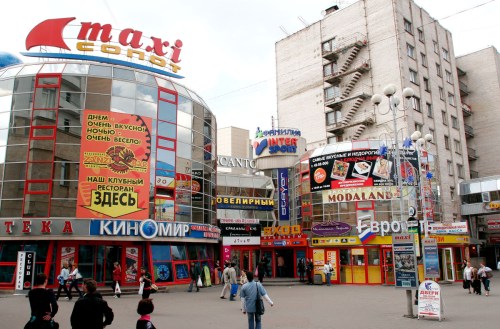
Traffic lights and metro doors

The traffic lights in Russia are a wannabe racecar driver’s dream. There’s no guessing when they’re going to change—they go from red to yellow to green, giving drivers time to rev their engines and start edging forward as pedestrians scurry for safety. And once they’ve turned green, timers count down to the next red light, so drivers know exactly how quickly they need to speed to make it through.

The life of the Russian pedestrian is less fun. There’s no requirement in St. Petersburg, as far as I can tell, that cars yield to pedestrians in crosswalks. Sure, sometimes they’ll slow down for you, but just as often, they’ll speed up—get out of the way or face the consequences.

What’s really fun, though, is crossing the street at a place without a stoplight—it’s sort of like human Frogger. St. Petersburg’s residents apparently have an excellent sense of timing.

But crossing the street isn’t the only place where the state won’t give you much of a helping hand.

When you’re getting on the metro, and the chime sounds signaling that the doors are about to close, you’d best be on the train. These aren’t nice American doors that open if you hurriedly shove a hand in. They close with a sharp thud, and you’re either in or you’re out.

I got “closed on” yesterday—it’s more surprising than painful, since the doors are at least padded with rubber. But whereas in America, one learns to shove an arm into the door to get on the train, here such stupidity doesn’t pay off.

It’s kind of nice, actually.

You have to take more responsibility for yourself—but you won’t be surprised if the striped paint on the street doesn’t make cars magically stop or if your rush to get on the train is rewarded with a bruise.

Potatoes for Dinner

We’re making potatoes for dinner tonight. I’d make a joke about how that’s typical Russian cuisine or something, but Russia actually has a pretty rich culinary tradition. I don’t know too much about it though, at least in part because I don’t eat meat.

But the whole Russia and potatoes (or vodka, etc) joke is the sort of comedy I’m going to try to avoid.

As much as I write about the differences between Russia and home, differences magnified by a difficult foreign language, St. Petersburg and its people have many of the same characteristics as big city denizens throughout the world. Sure, they smile less readily and they’re a bit quieter, but on the whole, the differences are minor.

Of course, people are more attuned to difference than similarity. And it’s also those differences that make foreign cultures so unique and interesting. So while I’ll keep blogging about the unique quirks that make St. Petersburg an interesting place to be, I don’t want to give anybody the impression that there’s a huge divide between “our culture” and the culture here.

Slideshow: Tsarskoye Selo

In Russia, things are often under repair, including the palaces.

In Russia, things are often under repair, including the palaces.

Tsarskoye Selo, a palace built by Catherine, lies on the outskirts of St. Petersburg. During the Second Great Patriotic War, Nazis occupied and trashed the palace, and stole the vaunted amber room. That room was recently restored, and is the only one in which pictures are forbidden during the tour.

For more photos from the castle and a few from around St. Petersburg, click here.

Smiling

Russians don’t smile. Not the ones that work in the service industry, anyhow. The uniquely American, “Thanks, and have a great day” doesn’t seem to have hopped on the boat to St. Petersburg with McDonalds and Pizza Hut.

At the metro, after you pass your 20 rubles through the window, they don’t even look at you before shoving a gold metro token at you. If, god forbid, you fumble for the correct bills or coins, several Russians are liable to push by you to purchase their entrance fares.

I’ll admit, it’s not like the Metro employees in D.C. are known for their friendliness either, and I’m sure they’ve put off more than one foreign tourist. But subway workers aren’t the only unsmiling ones.

I’ve already written some about the difficult cashiers at the Paterson supermarket, or универсам. From our travel guide, we recently learned that they’re colloquially referred to as гром баба, or thunder women. Makes me feel a bit better to know that Russians also incur their wrath.

Now, the woman I bought tea (another weapon in the continuing war against jet lag) and some food from today seemed nicer, or at least more low key. But she, too, hassled me as I tried to count out correct change (when the smallest common coin is 50 kopecks, that can be particularly tough). And I also learned that she spoke English—when she told me “You too slow” as I tried to put my change away while simultaneously juggling my purchases, because I had decided against purchasing another 6 ruble plastic bag.

We managed to steal a smile from a waitress today, however.

Restaurants and cafes in Russia are notorious for lacking many of the items listed on the menu. _____ нет, there isn’t any _____, is a common phrase for waiters and waitresses. Typically, food is ordered and delivered with as few words exchanged as possible, with the obvious exception of multiple “нет”s. There’s no friendly banter nor facial expressions, perhaps because tipping expectations are minimal, except in the fanciest establishments (apparently, in smaller cities, tipping means that you want to sleep with the waitress. Here, they’re more used to it.).

This means that the waiters won’t constantly bug you, asking you how your food is, or trying to move you along to make room for another table. It also means that they won’t ask you if you want something else, or offer you another bottle of water or soda—the savvy Russian restaurant-goer orders his whole meal, including dessert, upon sitting down.

There were six of us at the restuarant today, ordering Пироги, or Russian pastries, filled with anything from apple or orange to meat and fish. I actually went for a strange fried egg, cheese, and tomato dish, but only because the pastry I wanted – нет. So much of what we ordered was out that after asking for the umpteenth item and hearing the umpteenth нет, we finally earned a smile, and perhaps even a little laugh, from the waitress. Either that, or she was laughing at our mangled pronunciations of Russian food items.

City Tour

We saw the old KGB headquarters in St. Petersburg today; or rather, we saw the FSB building. It’s called большой дом, The Big House, and from the windows you can see Siberia, our guide joked.

Speaking of law enforcement and such, we also passed by the Peter and Paul Fortress, a low hexagonal island defense against the Swedes that was never used in war. Instead, it held political prisoners to 1917. Only one person, the anarchist Mikhail Bakunin, has ever escaped from the island, and he did it by getting transferred to a hospital.

Perhaps the coolest thing we glimpsed from the bus during our driving tour of the city was the cruiser Aurora. The Aurora, which survived the Russo-Japanese war, fired a blank at the Winter Palace at the start of the Bolshevik Revolution in 1917, and has therefore been immortalized for its role, however small, in bringing down the provisional government and carrying Lenin to power.

The ship has become a tourist trap of the highest degree. As we drove by, I noticed the row of stalls beside it hawking t-shirts and souvenirs to tourists. People posed for pictures sitting on the deck gun that fired the famous shot. The ship serves as a museum of Communist propaganda; across the river, however, stands the massive St. Petersburg Bank.

As we drove, we saw a few other interesting sites, like the St. Petersburg Mosque, built in the early 1900s, and a whole bunch of statues. The variety of statues here is pretty impressive, but it’s hard to keep them all straight (other than the Lenin statue in front of the Palace of Soviets. He’s pretty distinictive. I really want to take my picture in front of Lenin, but we’ve only driven by so far; we haven’t stopped.). Particularly impressive was The Bronze Horseman – a huge statue of Peter the Great on horseback.

Five Things Russians Like

Based on walking around St. Petersburg for two days (read: not on all that much), I bring you five things that Russians apparently find stylish.

  1. Mullets
  2. Punk Rock, especially Iron Maiden
  3. American NBA teams that are doing well
  4. Tight clothes
  5. Black (Shoes, pant, shirts, etc)

Slideshow: First days in Petersburg

The view from the steps of Primorskaya Metro, a block from our apartment.

The view from the steps of Primorskaya Metro, a block from our apartment.

Click here for a slideshow of photogaphs from my first few days in St. Petersburg.

Victory Day

5/9/09 – 23:30

The Church on Spilled Blood

The Church on Spilled Blood

“Write what you know” is probably one of the oldest clichés in creative circles. But in an unfamiliar city in a strange country speaking a language I can barely grasp, I don’t know a whole lot.

The archway leading to the Victory Day celebration.

The archway leading to the Victory Day celebration.

I know that today was Victory Day, День Победы, and that I glimpsed through the cracks in a wall of children perched on their parents’ shoulders a parade of military vehicles rumble by. I know that the children were excited to see the Katyusha rockets on their launchers pass through Dvortsovaya Square. I know that I heard hundreds—perhaps thousands, I couldn’t see very well—of soldiers in the square shout and react in unison to commands given from the podium, a martial Russian show for a day of Soviet military success.

The parade, from afar.

The parade, from afar.

Victory Day, I’m told, celebrates the Nazi German capitulation to Soviet forces in Berlin. Leningrad, as St. Petersburg was then called, bore a heavy burden during the conflict because the Nazis encircled it, choking it but never taking its streets. For its strangulation—the starvation and deprivation its residents endured—it is called a Hero City.

War Memorial

War Memorial

Many of Leningrad’s heroes were out today, wearing their military uniforms heavy with medals. They’re an old and dying generation, just as American veterans of the Second World War are, but I do not know their stories. I couldn’t really ask them; my language skills just aren’t there.

Accomplishments

The jet lag has been conquered, sort of. It’s 7:30 p.m., and I’m exhausted.

In the interest of brevity, I’m going to list some of today’s accomplishments. You’ll notice that a lot of them involve purchases; talking with people in Russian is tough.

  • Rode the metro to downtown St. Petersburg to watch the Victory Day parade.
  • Bought lunch (but the menu was in English and Russian).
  • Bought a surge protector.
  • Bought water from a vendor on the street.

More later, but for now, it’s time to get out and get some coffee in the interest of the continuing flight against jet lag.