Category Archives: Russia

The St. Petersburg Palace of Soviets

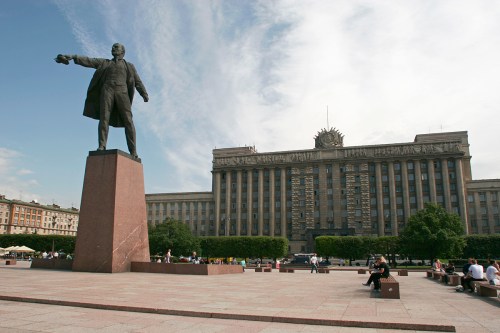
Lenin stands before the Palace of Soviets in St. Petersburg.

Lenin stands before the Palace of Soviets in St. Petersburg.

The Saint Petersburg Palace of Soviets was built by Josef Stalin in an attempt to relocate the city center away from the bourgeois downtown area. Stalin also hoped to have a magnificent building of his own to counterbalance all the Tsarist palaces in and around the city, such as The Hermitage and Tsarskoye Selo.

However, World War II stalled Stalin’s relocation plans, and the center of St. Petersburg remains in its bourgeois location. But even the area around the Palace of Soviets, on Moskovski Prospekt, is looking pretty upscale these days.

The massive statue of Lenin now glares at a Nike store and a Sberbank. Just down the road, hungry former party members can pick up a Big Mac and fries at McDonalds, and contemplate the massive hammer and sickle atop the palace while eating the best of American capitalism.

Even the palace fountains add to the upscale atmosphere. I mean, who ever heard of proletarian fountains?

Click here for more photos from the Palace of Soviets.

A Russian perspective on the Iranian Election

In an opinion piece in the St. Peteresburg Times, Yulia Latynina, a political commentator for a Moscow radio station, takes on the recent election and turmoil in Iran.

In the election results and ensuing protests, she sees not grass roots activism, not fraud and the response of an outraged people, but simply the pitfalls of democracy in a poor country. Latynina draws parallels between post-Soviet Russia and Iran, arguing that poor voters tend to elect bad leaders:

The Iranian vote demonstrates a simple truth that even Aristotle and Plato understood but that is frequently forgotten by fans of democracy today — namely that democracy is one of the worst forms of government if the majority of voters are impoverished…

All observers of democracy — from Thucydides to Machiavelli — have made note of one simple fact: If the voters do not own property, democracy does not differ from dictatorship and will inevitably end in tyranny.

Click here to read the full piece.

Photos: Boat Trip Down the Neva

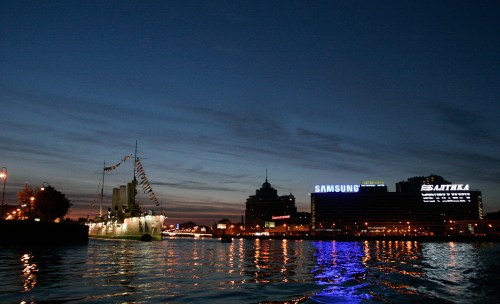
The Cruiser Aurora next to billboards on the Neva.

The Cruiser Aurora next to billboards on the Neva.

Click here for more photos from our cruise on the Neva River.

Photos: Churches and Monasteries around Vologda

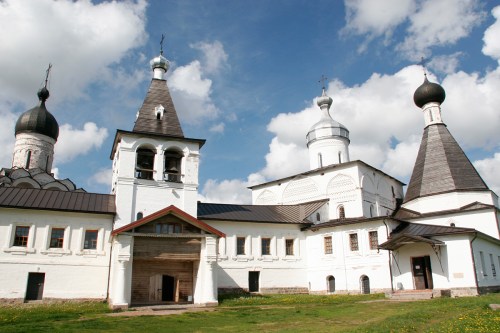
A monastery about 130 kilometers north of the city of Vologda.

A monastery about 130 kilometers north of the city of Vologda.

Click here for more photographs of churches and monasteries near Vologda.

Long days, cold showers

In major Russian cities, hot water is produced centrally in big plants and then pumped out to individual buildings. This saves Russians the expense of a hot water heater.

But during the two weeks each summer when those plants and pipes get their needed maintenance, it costs everyone their hot water.

(Read Pulitzer Prize winning journalist Clifford Levy’s account of the hot water shutoff in Moscow in the New York Times here.)

In my district of St. Petersburg, the hot water was turned off yesterday, and will remain off for about two weeks.

Generally, residents of St. Petersburg cope by bathing at the homes of friends in different districts or by heating their water on the stove and taking sponge baths. I’ve also been told that some people shower less, which should make the metro rides a bit more fun.

We, of course, don’t have friends in other parts of the city to bum showers from.

But luckily for us, our apartment actually has a small hot water heater in it. It should provide for some lukewarm showers, if it works.

Photos: Scenes around Vologda

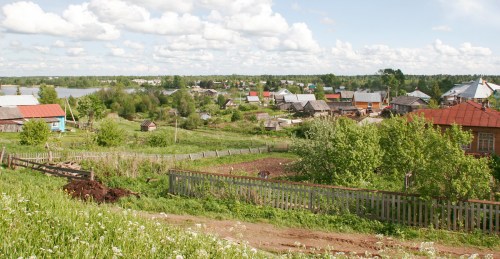
A small town about 130km north of Vologda.

A small town about 130km north of Vologda.

Click here for more photos from the area around Vologda.

Proletarian lace

Victory to the USSR

Lace: Victory to the USSR

Vologda is known for a few things, namely monasteries, dairy products, and lace.

Come October 1918, being an agricultural center famed for making such a bourgeois thing as lace wasn’t a mark in favor of Vologda in the minds of the Bolsheviks. Neither, of course, was Vologda’s pro-White (that’s Anti-Bolshevik) political orientation during the Russian Civil War.

Indeed, Vologda suffered heavily during Lenin’s Red Terror, and later during the collectivization imposed by Stalin (Not so much for making lace, but more because the area was largely populated by farmers).

In any event, the lace-makers of Vologda faced a challenge: how to reconcile their decidedly upper-class product with the Soviet Union’s proletarian ideals.

The solution: Lace glorifying industry, agriculture, and the Soviet Union, as we saw at the Vologda Lace Museum. Click here to see a few pieces of Soviet lace.

The overnight train to Vologda

My apologies for not putting up a post for the last week. It’s been busy since we returned from Vologda Monday morning. But I’ll be publishing lots of photos from Vologda over the next few weeks to try and make up for it.

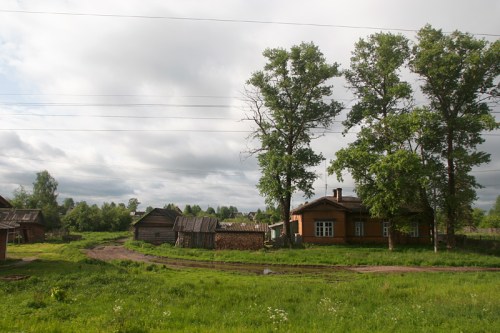
A countryside scene on the way to Vologda.

A countryside scene on the way to Vologda.

It takes about 12 hours by overnight train to cover the 600 kilometers from St. Petersburg straight east to Vologda, a small, “authentic,” Russian town. We, the whole Duke in St. Petersburg group, left for Vologda last Friday evening, spent two full days there, and returned to St. Petersburg early Monday morning.

Vologda is several times larger than Rockville, or for you Dukies, around the size of Durham, but it retains a small-town feel, perhaps because it’s population is spread over such a large area. Few tourists venture to Vologda, and just about zero Americans. It’s a pity, because Vologda and the surrounding area is beautiful, full of old Russian (15th-16th century) churches and monasteries, open countryside, and fresh air.

I’ll be writing more about Vologda as I sort through and post photos from my trip, but for now, click here to view photographs shot from the windows of our leisurely train ride.

A steel plant near Vologda.

A steel plant near Vologda.

So what the heck are you doing over there?

It’s been a while since I last wrote about what I’ve been doing in Russia. And those posts were only about gross potato chips and an interesting police encounter—nothing too exciting. So it looks like I owe you a post about what I’ve been up to for the past week).

Saturday,I went to a Zenit soccer (football) game in Petrovski Stadium. Zenit, St. Petersburg’s team, beat Kuban Kransodar 2-0 in an exciting match on a day with perfect soccer-watching weather. Sunny and warm.

To get into Petrovski Stadium, you have to pass through three police checkpoints. At the first, they search your bags. At the second, they search you. And at the third, bunches of police officers, dogs leashed, check you over again to be really, really sure that you’re not dangerous. While this didn’t dim the mood too much for the rowdy crowd, it’s definitely a reminder that you’re in Russia.

Zenit is not as good as the team has been in years past, but that didn’t stop the crowd from cheering and waving massive flags. And it also didn’t stop the mildly intoxicated, shirtless, middle-aged Russian man sitting next to us from yelling thing that I’d rather not print in this blog. I’ll give you a hint though—some of them involved the mothers of the opposing team.

It was on the way back from this game that I got stopped by the Russian police officer, as I wrote about earlier.

Most of the week since has been filled with homework, making food, sleeping, and the other regularities of daily life in any place. Homework, in particular, took up a lot of time this week. We read a 4-page Chekhov story, At the Dacha, which took hours of dictionary-fueled deciphering.

Once I figured it all out, I got a good laugh out of the story (No, I won’t tell you why. Go read it.). But looking up every word in every sentence tends to drain the love out of reading.

We’ve also been delving into every Russian student’s favorite subject: verbs of motion. Russia has different verbs for going long and short distances, by boat, or by plane, which also vary if you’re leading, driving, carrying, or taking an object by vehicle. And then, each multi-directional verb also has a unidirectional partner (you use one verb if you’re making a round-trip, a related one if you’re going one way). If that’s not enough there are a bevy of prefixes that can be affixed to any of these verbs, adding meanings such as entering, going to a large number of different places, or going a short distance back from a specific location.

We’ve been practicing by using these verbs, mostly jokingly, to describe our trips around the city. “We went by foot to the metro. We crossed to the correct platform. We entered the train. We took the train three stations… and went to a Duran Duran concert.”

The Duran Duran concert is no joke though.

Some genius party planner decided that the best way to celebrate the start of the International Economic Forum—a high-level (think Putin and Medvedev) conference being held in St. Petersburg on business innovation and the Russian and global economic crises—is to throw a giant, beer company-sponsored, free concert in the center of St. Petersburg, right next to the Hermitage art museum.

And what better band to bring a bunch of politicians (there was, of course, a VIP section) and economists to than the English rockers Duran Duran? I mean, there’s nothing an economist loves more than an 80’s flashback.

Unfortunately, Duran Duran was greeted by cold and rainy weather. So while the band tried to get the umbrella-toting crowd dancing (yes, we went), they must’ve felt like a bunch of American economists (or Russian central bankers) cutting interest rates to try to get the economy movin’ (or in Russia’s case, because runaway inflation is easing).

That’s the last financial crisis joke. I swear.

We only stayed for a few songs at the Thursday night concert—basically, long enough to say that we had, indeed, been to a Duran Duran show in St. Petersburg. We even got to hear the smash hit “Hungry Like the Wolf.”

In touch with the ground
I’m on the hunt, I’m after you
Smell like I sound, I’m lost in a crowd
And I’m hungry like the wolf.

And no, I have no frickin’ idea what “smell like I sound” means either.

Kirov’s Apartment and the perils of Communism

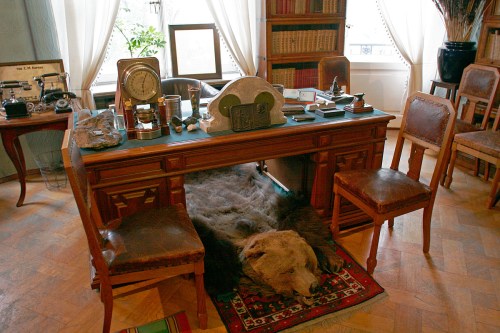
Sergei Kirov's desk.

Sergei Kirov's desk.

Sergei Kirov’s apartment now stands as a memorial to the slain Leningrad Party Boss and as a reminder of the worst features of Stalinism.

At first though, the apartment, reconstructed to early 1930s form from photographs, seems to commemorate the early achievements of the Soviet system.

Click here for more photos from Kirov’s apartment.

Kirov’s desk is filled with reports on industrial output from factories in the Leningrad region, highlighting the impressive industrialization achieved under the first Five Year Plan and part of the second. Trinkets from these plants show off their successes—Kirov’s apartment contains the first typewriter made in the Soviet Union and models of many other industrial products, ranging from a steel bar to a tank. Photos show the construction of river dams and massive factories, and note Kirov’s inspection visits to some of these behemoths.

The explanatory text boasts of Kirov’s popularity among Leningrad workers and his closeness to other Soviet leaders. Stalin, it says, ate in Kirov’s dining room.

But Kirov’s dinner guest ultimately became his killer. And that same killer—after orchestrating Kirov’s assassination—embarked on a rampage of repression that resulted in the imprisonment and execution of millions.

The 1934 assassination of Kirov, likely on Josef Stalin’s orders, is generally considered to have signaled the beginning of these purges. During the purge period, several million people were killed (estimates vary widely, but many sources cite NKVD records stating that about 700,000 were executed in 1937-38 alone, at the height of the purges) and millions more were sent to labor camps, called gulags, where some died from starvation, disease, or cold.

I’ve written before about the conflict over Stalin’s legacy, which owes to the fact that the same Soviet leader who executed so many of his own also led his country to victory in the Second World War. But Kirov’s apartment is ultimately a memorial—not a monument—for a system that executed its most promising leaders and struck fear into the hearts of its citizens.