Category Archives: Uncategorized

Smiling

Russians don’t smile. Not the ones that work in the service industry, anyhow. The uniquely American, “Thanks, and have a great day” doesn’t seem to have hopped on the boat to St. Petersburg with McDonalds and Pizza Hut.

At the metro, after you pass your 20 rubles through the window, they don’t even look at you before shoving a gold metro token at you. If, god forbid, you fumble for the correct bills or coins, several Russians are liable to push by you to purchase their entrance fares.

I’ll admit, it’s not like the Metro employees in D.C. are known for their friendliness either, and I’m sure they’ve put off more than one foreign tourist. But subway workers aren’t the only unsmiling ones.

I’ve already written some about the difficult cashiers at the Paterson supermarket, or универсам. From our travel guide, we recently learned that they’re colloquially referred to as гром баба, or thunder women. Makes me feel a bit better to know that Russians also incur their wrath.

Now, the woman I bought tea (another weapon in the continuing war against jet lag) and some food from today seemed nicer, or at least more low key. But she, too, hassled me as I tried to count out correct change (when the smallest common coin is 50 kopecks, that can be particularly tough). And I also learned that she spoke English—when she told me “You too slow” as I tried to put my change away while simultaneously juggling my purchases, because I had decided against purchasing another 6 ruble plastic bag.

We managed to steal a smile from a waitress today, however.

Restaurants and cafes in Russia are notorious for lacking many of the items listed on the menu. _____ нет, there isn’t any _____, is a common phrase for waiters and waitresses. Typically, food is ordered and delivered with as few words exchanged as possible, with the obvious exception of multiple “нет”s. There’s no friendly banter nor facial expressions, perhaps because tipping expectations are minimal, except in the fanciest establishments (apparently, in smaller cities, tipping means that you want to sleep with the waitress. Here, they’re more used to it.).

This means that the waiters won’t constantly bug you, asking you how your food is, or trying to move you along to make room for another table. It also means that they won’t ask you if you want something else, or offer you another bottle of water or soda—the savvy Russian restaurant-goer orders his whole meal, including dessert, upon sitting down.

There were six of us at the restuarant today, ordering Пироги, or Russian pastries, filled with anything from apple or orange to meat and fish. I actually went for a strange fried egg, cheese, and tomato dish, but only because the pastry I wanted – нет. So much of what we ordered was out that after asking for the umpteenth item and hearing the umpteenth нет, we finally earned a smile, and perhaps even a little laugh, from the waitress. Either that, or she was laughing at our mangled pronunciations of Russian food items.
The sixth thing Russians like

Sushi.

You can buy Sushi everywhere.

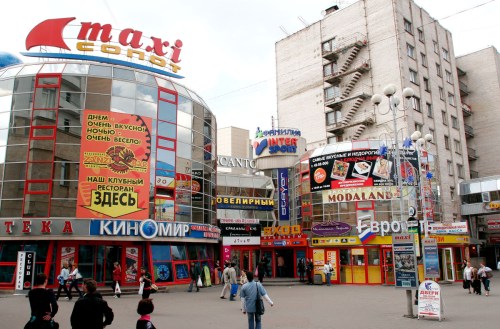
Sometimes, they spell it in Russian: Суши. Sometimes in English.

Given that we’re on the Gulf, I’m hoping it’ll be pretty good. I haven’t tried it yet; I want to stick to authentic Russian food (and Pizza.ru) for as long as possible.

Click here for the other five.

City Tour

We saw the old KGB headquarters in St. Petersburg today; or rather, we saw the FSB building. It’s called большой дом, The Big House, and from the windows you can see Siberia, our guide joked.

Speaking of law enforcement and such, we also passed by the Peter and Paul Fortress, a low hexagonal island defense against the Swedes that was never used in war. Instead, it held political prisoners to 1917. Only one person, the anarchist Mikhail Bakunin, has ever escaped from the island, and he did it by getting transferred to a hospital.

Perhaps the coolest thing we glimpsed from the bus during our driving tour of the city was the cruiser Aurora. The Aurora, which survived the Russo-Japanese war, fired a blank at the Winter Palace at the start of the Bolshevik Revolution in 1917, and has therefore been immortalized for its role, however small, in bringing down the provisional government and carrying Lenin to power.

The ship has become a tourist trap of the highest degree. As we drove by, I noticed the row of stalls beside it hawking t-shirts and souvenirs to tourists. People posed for pictures sitting on the deck gun that fired the famous shot. The ship serves as a museum of Communist propaganda; across the river, however, stands the massive St. Petersburg Bank.

As we drove, we saw a few other interesting sites, like the St. Petersburg Mosque, built in the early 1900s, and a whole bunch of statues. The variety of statues here is pretty impressive, but it’s hard to keep them all straight (other than the Lenin statue in front of the Palace of Soviets. He’s pretty distinictive. I really want to take my picture in front of Lenin, but we’ve only driven by so far; we haven’t stopped.). Particularly impressive was The Bronze Horseman – a huge statue of Peter the Great on horseback.

Five Things Russians Like

Based on walking around St. Petersburg for two days (read: not on all that much), I bring you five things that Russians apparently find stylish.

  1. Mullets
  2. Punk Rock, especially Iron Maiden
  3. American NBA teams that are doing well
  4. Tight clothes
  5. Black (Shoes, pant, shirts, etc)

Black Coffee

5/10/09 – 14:30

I’ve figured out the coffee situation here. Seems that no one really drinks black coffee, the kind I like. In Coffee House, when I asked for black coffee, the waitress looked surprised. She asked «без молоко,» without milk?, several times, but I thought she got what I wanted.

What she brought out, however, was nothing like the coffee I drink in the U.S. I got a mug about a quarter full of dark black coffee, or perhaps espresso, a small cup of milk, and instructions, mimed by the waitress, to add sugar from the jar at the table. So I did as she said and enjoyed my milky-sweet-definitely-not-black coffee, still determined to figure out how to get a full cup of dark full-bodied joe.

Later, we found ourselves at Coffee Club near our apartment, in need of caffeine to stay awake for a few more hours and deal jet lag another blow. There, I ordered some sort of mocha, which came piled with whipped cream. Nice, but not a daily drink.

Tom, however, ordered an Americano. Turns out, that’s the closest thing to black coffee you can get here. And even then, they’ll bring you enough sugar with it to bake a cake. So from now on, it’s—perhaps all too appropriately—Americanos for me.

With my Americano this morning, I had, for my first time here, something distinctly Russian: бутербродь c kрасное uкрой-an open sandwich with red caviar.

At Café Bar, which, with its wooden walls, wooden floor, and wooden chairs, resembles a hunting lodge, I tackled a menu entirely in Russian. So, that I had a caviar sandwich stems, at least partly, from the fact that caviar and sandwich are two of the few food-related Russian words I know. But that vocabulary is growing quickly out of necessity. Can’t wait til I can order a whole meal (one that’s без мясо-without meat)!

Slideshow: First days in Petersburg

The view from the steps of Primorskaya Metro, a block from our apartment.

The view from the steps of Primorskaya Metro, a block from our apartment.

Click here for a slideshow of photogaphs from my first few days in St. Petersburg.

Victory Day

5/9/09 – 23:30

The Church on Spilled Blood

The Church on Spilled Blood

“Write what you know” is probably one of the oldest clichés in creative circles. But in an unfamiliar city in a strange country speaking a language I can barely grasp, I don’t know a whole lot.

The archway leading to the Victory Day celebration.

The archway leading to the Victory Day celebration.

I know that today was Victory Day, День Победы, and that I glimpsed through the cracks in a wall of children perched on their parents’ shoulders a parade of military vehicles rumble by. I know that the children were excited to see the Katyusha rockets on their launchers pass through Dvortsovaya Square. I know that I heard hundreds—perhaps thousands, I couldn’t see very well—of soldiers in the square shout and react in unison to commands given from the podium, a martial Russian show for a day of Soviet military success.

The parade, from afar.

The parade, from afar.

Victory Day, I’m told, celebrates the Nazi German capitulation to Soviet forces in Berlin. Leningrad, as St. Petersburg was then called, bore a heavy burden during the conflict because the Nazis encircled it, choking it but never taking its streets. For its strangulation—the starvation and deprivation its residents endured—it is called a Hero City.

War Memorial

War Memorial

Many of Leningrad’s heroes were out today, wearing their military uniforms heavy with medals. They’re an old and dying generation, just as American veterans of the Second World War are, but I do not know their stories. I couldn’t really ask them; my language skills just aren’t there.

Accomplishments

The jet lag has been conquered, sort of. It’s 7:30 p.m., and I’m exhausted.

In the interest of brevity, I’m going to list some of today’s accomplishments. You’ll notice that a lot of them involve purchases; talking with people in Russian is tough.

  • Rode the metro to downtown St. Petersburg to watch the Victory Day parade.
  • Bought lunch (but the menu was in English and Russian).
  • Bought a surge protector.
  • Bought water from a vendor on the street.

More later, but for now, it’s time to get out and get some coffee in the interest of the continuing flight against jet lag.

Arriving in Russia

5/8/09 – 23:00

A short flight over the Gulf of Finland, a deep blue bordered on all sides by green, set the scenic backdrop for our arrival in St. Petersburg. As we came over the city, its pervasive grayness—a slightly outmoded industrial quality—filled the hazy air. Power lines, massive apartment blocks, and factory complexes stretched through my field of view as the plane descended to Polkovo airport on the city’s outskirts.

On deplaning, we were greeted by a short, stern-faced man who said nothing as he pointed his temperature gun at each of us; no “Welcome to Russia” here, but thankfully, no swine flu either.

Past customs, the mood lightened considerably as we were met by Саша (Sasha), our Russian discussion instructor from first semester. From there, we threw our bags into a small truck with a green-canvas-covered bed and settled into a white mix between a van and a bus for our ride to Капитанская Улица (Kapitanskaya Street), situated right on the Gulf of Finland.

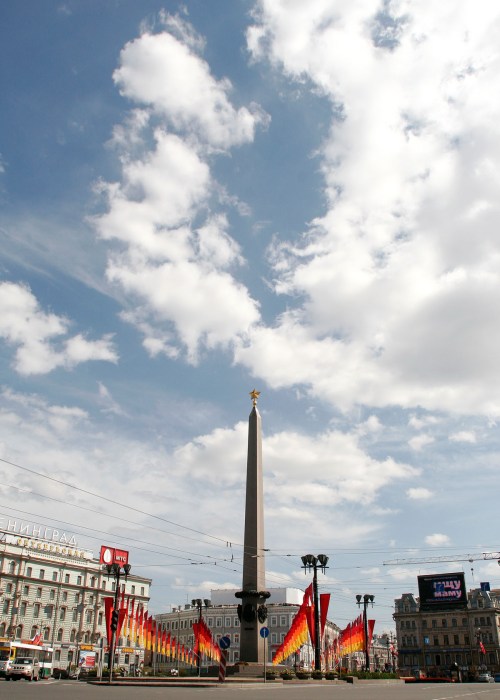
As we drove, St. Petersburg came into focus as a city, it’s character clearly unbounded by the industrial grayness that I saw from above. We passed a Kentucky Fried Chicken and a giant statue of Lenin, whose name the city once bore. Monuments to Tsars and Soviet soldiers filled the centers of enormous circles that seemed to give the traffic—everything from old Ladas to modern Porsches and Toyotas, and even a few American cars—some semblance of order.

Numerous supermarkets, markets, drug stores, convenience stores, clothing stores, and sundry other shops lined the streets, their gaudy signs advertrising their wares, and often, their 24/7 schedules. We strained to decipher the letters on some of the fleeting signs, and painstakingly sounded-out cyrillic filled the bus-van, accompanied, sometimes, by cheers marking the recognition of a remembered vocabulary word. Frequently though, the names were comfortably familar; Кафе (café), суши (sushi) and бар (bar) were only the tip of the iceberg.

But the city, what little of it we explored in our first hours in Russia, hummed to a beat distinct from anything that might be suggested by superficial sign similarities.

Shopping for food was a fascinating, and humbling, experience. Tomato sauce, of the kind we are so used to in America, was impossible to find at the  supermarket we went to. Also missing were spices, crackers beyond a single brand, and all the many styles of granola bar that are ubiquitous at home.

Eggs are packed 10 to a carton—strange.

The checkout aisle marked our first linguistic challenge. As the cashier rang up our bread, cheese, pasta, and massive jugs of water, she asked us if we wanted bags. We quickly declined, only to realize a few seconds later what we had done. Bags being an unfamilar word to us, we couldn’t figure out how to ask for them, except by pointing to one after the cashier had finished ringing us up.

Plastic bags (пакеты – a word I will not soon forget) cost six rubles, the cashier snarled. She waved away Tom’s 100 ruble bill, demanding exact change. The phrase «I just arrived and only have large bills» not being a part of our vocabulary, Tom dug around and handed the cashier a coin that said 5 and another that said 1. Her annoyance visibly increased at being handed a ruble and five kopecks, the cashier finally, mercifully, accepted Tom’s 100 ruble bill (worth, roughly, $3), and doled out all 94 rubles in change, pissed as hell. We quickly shoved our purchases into the bag and escaped, chastened and nervous for future shopping encounters.

Pre-planning vocabulary became the order of the day for our other big purchase – a map of the city. Fortunately, the vendor in the magazine stall was more understanding of our limited Russian skills, and the smoothness of this exchange provided a much-need confidence boost. Tom also managed to buy a memory card reader from an electronics kiosk located in, of all places, a pet shop.

Tomorrow, to wipe out jet lag, we plan to get up around 8 a.m., in plenty of time to go watch the Victory Day parade through the city center.

Stopping in Finland, briefly

The Helsinki airport has free WiFi. Finland – 1 America – 0.

Everything in this airport is made out of wood. The walls. The stall doors in the bathroom. The floor tiles. It gives off a nice vibe, sort of like walking into a mountain lodge. 

But more to the point, I’ve been realizing how many “firsts” today has brought:

  1. First time flying over a big body of water.
  2. First time on FinnAir (and on an Airbus A330)
  3. First time in Europe (and Finland, and soon to be – Russia).
  4. First time being anywhere where the native language isn’t English.
  5. And soon, it’ll be my first time going through customs. Russian customs, at that.

I’m sure I’m missing a few, but needless to say, I’m excited, and the adventure has only just begun. I’m hoping that the adrenaline from said adventurous feelings will carry me through the day. I’ve been up since 6:45 a.m., East Coast time on Thursday and it’s now about 9 a.m. here. I’m feeling it a bit. The plan is to run through to St. Petersburg, crash tonight, and instantly adjust to the time change. I’ll let you know how that goes.