Category Archives: Uncategorized

Irony, Russian Style

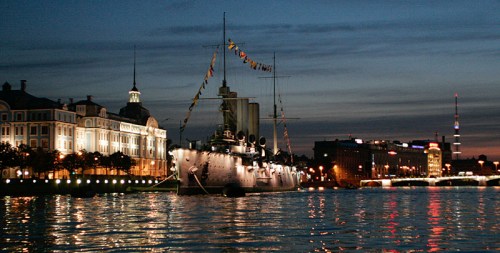
The Aurora

The Aurora

I was going to try to write something witty about revelations that a Russian billionaire threw a party last week on the cruiser Aurora, which famously fired a blank shell at the Winter Palace during the 1917 Bolshevik takeover, and is now a museum of Communist propaganda. But seriously, just read this article about the “Capitalist Orgy” from the St. Petersburg Times. I have nothing to add.

Proletarian lace

Victory to the USSR

Lace: Victory to the USSR

Vologda is known for a few things, namely monasteries, dairy products, and lace.

Come October 1918, being an agricultural center famed for making such a bourgeois thing as lace wasn’t a mark in favor of Vologda in the minds of the Bolsheviks. Neither, of course, was Vologda’s pro-White (that’s Anti-Bolshevik) political orientation during the Russian Civil War.

Indeed, Vologda suffered heavily during Lenin’s Red Terror, and later during the collectivization imposed by Stalin (Not so much for making lace, but more because the area was largely populated by farmers).

In any event, the lace-makers of Vologda faced a challenge: how to reconcile their decidedly upper-class product with the Soviet Union’s proletarian ideals.

The solution: Lace glorifying industry, agriculture, and the Soviet Union, as we saw at the Vologda Lace Museum. Click here to see a few pieces of Soviet lace.

The overnight train to Vologda

My apologies for not putting up a post for the last week. It’s been busy since we returned from Vologda Monday morning. But I’ll be publishing lots of photos from Vologda over the next few weeks to try and make up for it.

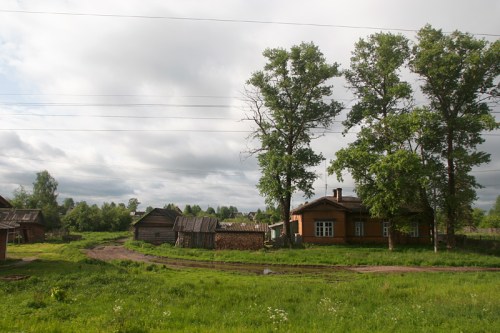
A countryside scene on the way to Vologda.

A countryside scene on the way to Vologda.

It takes about 12 hours by overnight train to cover the 600 kilometers from St. Petersburg straight east to Vologda, a small, “authentic,” Russian town. We, the whole Duke in St. Petersburg group, left for Vologda last Friday evening, spent two full days there, and returned to St. Petersburg early Monday morning.

Vologda is several times larger than Rockville, or for you Dukies, around the size of Durham, but it retains a small-town feel, perhaps because it’s population is spread over such a large area. Few tourists venture to Vologda, and just about zero Americans. It’s a pity, because Vologda and the surrounding area is beautiful, full of old Russian (15th-16th century) churches and monasteries, open countryside, and fresh air.

I’ll be writing more about Vologda as I sort through and post photos from my trip, but for now, click here to view photographs shot from the windows of our leisurely train ride.

A steel plant near Vologda.

A steel plant near Vologda.

So what the heck are you doing over there?

It’s been a while since I last wrote about what I’ve been doing in Russia. And those posts were only about gross potato chips and an interesting police encounter—nothing too exciting. So it looks like I owe you a post about what I’ve been up to for the past week).

Saturday,I went to a Zenit soccer (football) game in Petrovski Stadium. Zenit, St. Petersburg’s team, beat Kuban Kransodar 2-0 in an exciting match on a day with perfect soccer-watching weather. Sunny and warm.

To get into Petrovski Stadium, you have to pass through three police checkpoints. At the first, they search your bags. At the second, they search you. And at the third, bunches of police officers, dogs leashed, check you over again to be really, really sure that you’re not dangerous. While this didn’t dim the mood too much for the rowdy crowd, it’s definitely a reminder that you’re in Russia.

Zenit is not as good as the team has been in years past, but that didn’t stop the crowd from cheering and waving massive flags. And it also didn’t stop the mildly intoxicated, shirtless, middle-aged Russian man sitting next to us from yelling thing that I’d rather not print in this blog. I’ll give you a hint though—some of them involved the mothers of the opposing team.

It was on the way back from this game that I got stopped by the Russian police officer, as I wrote about earlier.

Most of the week since has been filled with homework, making food, sleeping, and the other regularities of daily life in any place. Homework, in particular, took up a lot of time this week. We read a 4-page Chekhov story, At the Dacha, which took hours of dictionary-fueled deciphering.

Once I figured it all out, I got a good laugh out of the story (No, I won’t tell you why. Go read it.). But looking up every word in every sentence tends to drain the love out of reading.

We’ve also been delving into every Russian student’s favorite subject: verbs of motion. Russia has different verbs for going long and short distances, by boat, or by plane, which also vary if you’re leading, driving, carrying, or taking an object by vehicle. And then, each multi-directional verb also has a unidirectional partner (you use one verb if you’re making a round-trip, a related one if you’re going one way). If that’s not enough there are a bevy of prefixes that can be affixed to any of these verbs, adding meanings such as entering, going to a large number of different places, or going a short distance back from a specific location.

We’ve been practicing by using these verbs, mostly jokingly, to describe our trips around the city. “We went by foot to the metro. We crossed to the correct platform. We entered the train. We took the train three stations… and went to a Duran Duran concert.”

The Duran Duran concert is no joke though.

Some genius party planner decided that the best way to celebrate the start of the International Economic Forum—a high-level (think Putin and Medvedev) conference being held in St. Petersburg on business innovation and the Russian and global economic crises—is to throw a giant, beer company-sponsored, free concert in the center of St. Petersburg, right next to the Hermitage art museum.

And what better band to bring a bunch of politicians (there was, of course, a VIP section) and economists to than the English rockers Duran Duran? I mean, there’s nothing an economist loves more than an 80’s flashback.

Unfortunately, Duran Duran was greeted by cold and rainy weather. So while the band tried to get the umbrella-toting crowd dancing (yes, we went), they must’ve felt like a bunch of American economists (or Russian central bankers) cutting interest rates to try to get the economy movin’ (or in Russia’s case, because runaway inflation is easing).

That’s the last financial crisis joke. I swear.

We only stayed for a few songs at the Thursday night concert—basically, long enough to say that we had, indeed, been to a Duran Duran show in St. Petersburg. We even got to hear the smash hit “Hungry Like the Wolf.”

In touch with the ground
I’m on the hunt, I’m after you
Smell like I sound, I’m lost in a crowd
And I’m hungry like the wolf.

And no, I have no frickin’ idea what “smell like I sound” means either.

Kirov’s Apartment and the perils of Communism

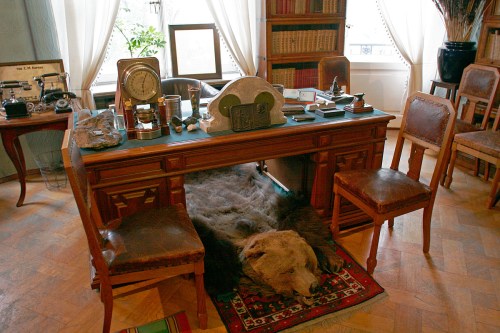
Sergei Kirov's desk.

Sergei Kirov's desk.

Sergei Kirov’s apartment now stands as a memorial to the slain Leningrad Party Boss and as a reminder of the worst features of Stalinism.

At first though, the apartment, reconstructed to early 1930s form from photographs, seems to commemorate the early achievements of the Soviet system.

Click here for more photos from Kirov’s apartment.

Kirov’s desk is filled with reports on industrial output from factories in the Leningrad region, highlighting the impressive industrialization achieved under the first Five Year Plan and part of the second. Trinkets from these plants show off their successes—Kirov’s apartment contains the first typewriter made in the Soviet Union and models of many other industrial products, ranging from a steel bar to a tank. Photos show the construction of river dams and massive factories, and note Kirov’s inspection visits to some of these behemoths.

The explanatory text boasts of Kirov’s popularity among Leningrad workers and his closeness to other Soviet leaders. Stalin, it says, ate in Kirov’s dining room.

But Kirov’s dinner guest ultimately became his killer. And that same killer—after orchestrating Kirov’s assassination—embarked on a rampage of repression that resulted in the imprisonment and execution of millions.

The 1934 assassination of Kirov, likely on Josef Stalin’s orders, is generally considered to have signaled the beginning of these purges. During the purge period, several million people were killed (estimates vary widely, but many sources cite NKVD records stating that about 700,000 were executed in 1937-38 alone, at the height of the purges) and millions more were sent to labor camps, called gulags, where some died from starvation, disease, or cold.

I’ve written before about the conflict over Stalin’s legacy, which owes to the fact that the same Soviet leader who executed so many of his own also led his country to victory in the Second World War. But Kirov’s apartment is ultimately a memorial—not a monument—for a system that executed its most promising leaders and struck fear into the hearts of its citizens.

Russian prison spokesman: allegedly-tortured inmate beat himself

A Russian journalist says Zubayr Zubayrayev, imprisoned in Volgograd, was tortured because he is Chechen.

But Russian authorities say the man admitted in a videotape to beating himself, and a Russian court has fined the journalist 200,000 rubles (about $6,500) and ordered that she retract her articles, The Moscow Times reports.

The journalist, Yelena Maglevannaya, refused, and has fled to Finland, where she is currently seeking asylum.

According to The Moscow Times, Maglevannaya also received death threats after her stories about Zubayrayev were published.

She is far from the only journalist to be threatened for her work in Russia.

The Moscow Times noted:

More than 15 Russian journalists covering political issues have requested asylum abroad since Vladimir Putin assumed power nine years ago, said Oleg Panfilov, director of the Center for Journalism in Extreme Situations.

“They can’t stand the working conditions [in Russia],” Panfilov said.

But the ones who have fled abroad are perhaps the luckiest.

Sixteen Russian journalists have been killed due to their reporting in Russia since 1999, according to the Committee to Protect Journalists. Fifteen of the murders remain unsolved, CPJ said, including those of Forbes editor Paul Klebnikov, an American, and Novaya Gazeta reporter and author Anna Politkovskaya, who reported from Chechnya and wrote critically on the current state of affairs in Russia.

Suppressing dissent in a ‘democracy’

Somebody want to protest, and you just don’t feel like giving them permission?

Schedule a large event for the same time and place. And meet the demonstrators with cops. Lots of cops.

The Russian government followed this recipe to a T in dealing with a planned protest in Moscow by Eduard Limonov’s National-Bolshevik Party. NBP is a highly nationalistic party with few followers and little ideology, beyond a strident opposition to the current government.

Limonov has been accused of shifting his beliefs to attract media attention. At one time, NBP espoused pro-Stalin rhetoric. It is now more closely aligned with pro-Western groups.

But whatever Limonov’s beliefs, he has been devilishly effective in attracting media attention—though Sunday’s rally gone awry went little-noticed.

As the Associated Press reported, Limonov and at least ten supporters were arrested by Russian special forces (OMON) after attempting to protest against Russian Prime Minister Vladimir Putin. The rally hasn’t been reported on in the English-language Russian papers I read, though the more sensationalistic MOSNEWS did report on the rally, adding a few details to the AP report.

Why dodge the Russian draft?

After yesterday’s post on police checking ID to find draft-dodgers, I want to add a bit of context as to why young men try so hard to stay out of the Russian military.

In a word, it comes down to hazing. I’m no expert on hazing in the Russian armed forces, but here is what I do know:

  • In 2004, at least 44 (Government figure), and as many as 3,000 (human rights group estimate) Russian draftees were killed in hazing incidents or commited suicide as a result of hazing. (Source: Pravda)
  • In the same year, Human Rights Watch released a report on hazing in the Russian military, and called on the government to do more to stop it. HRW estimated that hazing caused the “deaths of dozens of conscripts every year, and serious—and often permanent—damage to the physical and mental health of thousands others. Hundreds of conscripts commit or attempt suicide each year, and thousands run away from their units.”
  • In 2006, Private Andrei Sychyov was beaten so badly that his legs and genitals had to be amputated. His case was one of the few to be publicly discussed in Russia, because the doctors treating him leaked information to the media. (Sources: Radio Free Europe, NPR)
  • After Sychyov’s case became public, news outlets discovered another case at least as disturbing.
  • The St. Petersburg Times reported on the humiliation, beating, extortion and other trials Russian conscripts face following the Sychyov case. Despite the testimony of a hazed soldier, Russia’s Defense Minister dismissed continuing concerns about hazing.

Documents, please

Every time I walk past a police officer in St. Petersburg, I look down, up, to the side—anywhere but his face. It’s not that I’m guilty of anything, but here the militsia, as the St. Petersburg police are called, are not known for jolly attitudes and community outreach. They also do not need a reason to ask for your documents, an open request that can lead to questioning in an unfamiliar language and to the gifting of pastel-colored Ruble notes.

I’ve played out the scenario many times in my mind: An officer’s eye meets mine. Nightstick dangling from his wrist—Russian police seem to always have their nightsticks out and ready—he approaches. As I pull my photocopied passport (And here’s the technical guilt: By law, one is required to have the actual passport with him at all times) out of my wallet, he sizes up its monetary contents. He questions me. I tell him—in English—that I speak no Russian, as I’ve been advised to do. He suggests a ruble figure. I comply, replacing my passport in my now-lighter wallet, walking away, if all goes well.

Today, my imagination met reality.

As I walked into Vaselostravskaya Metro Station, a police officer, standing to the side with two others, stopped me. “Документы, пожалуйста,” documents please. As I’d practiced, I told him that I speak no Russian as I unfolded the crumpled copy of my passport. “Ah, American,” he said. And smiled. One of his partners added in a “Hello, American.” The young officer, no club in hand, gave me back my passport, and I was on my way.

Apparently, the police are not looking to bother American students, or to earn an easy several-hundred rubles.

According to the St. Petersburg Times, what the police are looking for is draft dodgers—young men trying to escape their mandatory time in Russia’s military. Spring is draft time, so the police may (they deny this, according to the St. Petersburg Times) be ratcheting up efforts to fill the military’s ranks, in part by checking the documents of young men at metro stations.

Taste Test: Red Caviar Lays

Red Caviar Lays

Red Caviar Lays

When you open a bag of Red caviar flavored Lays potato chips, the fish aroma is absolutely unmistakble. In fact, the scent of fish emanating from potato chips is a bit odd, a bit disturbing, and perhaps, a bit scary.

The chips taste like they’re supposed to. Which is to say that they taste like fried potatos, salt, and caviar. But the chips lack the distinctly slimey and chewy texture of fish eggs, which one expects from the taste. All in all, a disorienting experience. And unfortunately, the bag remains unfinished—hoping my room mates will want some.