
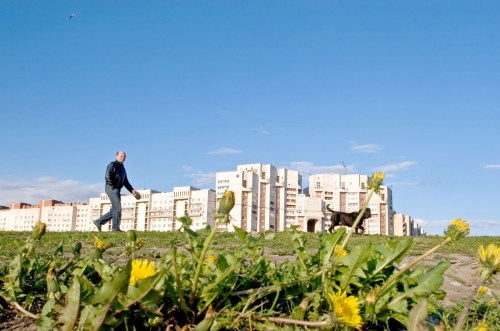
A man walks his dog in a strip of grass adjacent to the Gulf of Finland.
A man walks his dog in a strip of grass adjacent to the Gulf of Finland.
Tagged dog, gulf of finland, nature, photo, St. Petersburg

The Saint Petersburg Mosque
The St. Petersburg Mosque, when it was completed in the waning days of the last Tsar, could hold many of St. Petersburg’s 8,000 Muslims. The massive mosque stands tall near the Neva River, not far from the Peter and Paul Fortress and other central St. Petersburg landmarks.
That the mosque survived the Bolshevik Revolution and the siege of Leningrad is incredible. However, the beautiful building was used as a warehouse starting in the 1940’s, and was only allowed to again function as a mosque at the request of Indonesia’s president in 1956. The mosque continues to serve St. Petersburg Muslims to this day, and the interior of the building is open only to members
Posted in Russia
Tagged bolshevilk, Culture, mosque, muslim, Neva, photo, siege, St. Petersburg
We went to the American Embassy in St. Petersburg today.
It has golden arches and serves Биг Мак and гамбургер (That’s Big Macs and hamburgers).
Seriously though, the McDonalds menu is almost identical in Russia—all the food items are transliterated in Cyrillic, even my филет-о-фиш (fillet-o-fish), and there really isn’t anything uniquely Russian.
The McFlurrys (Макфлурри), though, do come in different flavors: chocolate-caramel and chocolate-cherry. I tried chocolate-cherry. It did not disappoint.
The restaurant itself, across from Pushkinskaya Metro Station, is rather upscale by American McDonalds’ standards.
It boasts free Wi-Fi, and dinner time saw a crowd of well-dressed Russians besiege the cashiers (lines work a bit differently here), while others, mostly student-looking types, sat on brown faux(?)-leather stools and chairs and pecked away at laptops perched on bright white tables.
Country music played in the background as families enjoyed their fast food, wrapped in packages identical to their American counterparts, except for the Cyrillic script.
Even the friendly McDonalds atmosphere seemed to infect the joint, to a point—the cashier smiled as I fumbled the Russian words for chocolate-cherry, and thanked me after I had paid for my ice-cream drink and fish sandwich, in English!
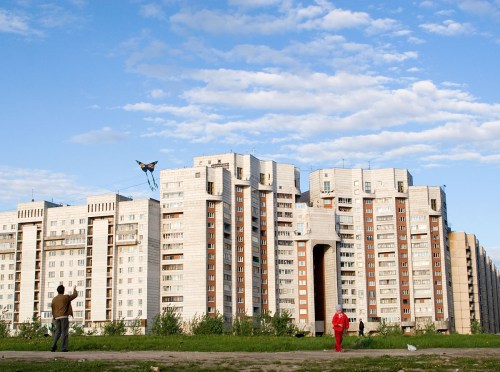
A man flies a kite near the Gulf of Finland.

The Winter Palace, also called The Hermitage, houses a huge number of pieces of Western art. In front of the palace is Palace Square, site of the 1905 Bloody Sunday Massacre.
The Winter Palace, or Hermitage, now houses a massive collection of European art. Prior to 1917, it was the official residence of the Russian Tsar. It was also the site of the provisional government following the Tsar’s overthrow, and was stormed and ransacked during the Bolshevik Revolution.
Click here to see a few photographs from inside The Winter Palace.
Tagged art, Bolshevik, Hermitage, museum, St. Petersburg, tsar, Winter Palace

I'm not sure what this sign is warning of, but it doesn't look good.
Any guesses as to what this sign might be warning about?
Forget about the title. For titillation, turn elsewhere. This post is actually about medical privacy.
Dr. Igor Knayzkin, the chief prostate researcher of the Russian Academy of Natural Sciences, runs a venereal disease, prostate, and general sexual health center in a light pink building on the edge of the Tauride Palace gardens.
Dr. Knayzkin’s clinic, however, also houses a small collection of erotica in glass cases in its white, medical hallways.
Enter the center, proceed past the first images of naked women, pay the receptionist—the same one that checks in patients—100 rubles ($3), and you’ll be given blue plastic covers to put over your shoes.
Slip the covers over your shoes, proceed past the patients in the waiting room, and enter the medical center hallways to examine the cases of sexual sculptures, phallic figurines, coffee mugs with balls, and the requisite Greek and African erotic art.
Make sure to stay out of the way of the white-coated attendants exiting exam rooms in the same hallway and the patients fresh from their various intimate appointments.
Russians, apparently, aren’t quite as fanatical about their medical privacy—HIPAA remains an American innovation.
But even if you are a bit embarrassed by camera touting tourists traipsing by as your testicles are examined, perhaps there’s good reason to go to Dr. Knayzin’s clinic. And that reason has nothing to do with the prominent doctor’s medical skill, or all the ads he has bought in the St. Petersburg metro.
You see, the medical center houses the embalmed 30 centimeter penis that allegedly once belonged to Grigori Rasputin, an incredibly odd character and close adviser to the last Tsar, Nicholas II.
Simply viewing the member is said to cure impotence (Warning: Link contains an image of said device). In any event, it’s a heck of a lot cheaper than any scientifically proven remedy.
—
Pravda, the newspaper of Russia’s Communist Party, covered the museum’s 2004 opening and scored an apparently-exclusive interview with a Rasputin descendant:
Rasputin’s great grandchild John Nekmerson is currently living in the US. He is a grandchild of Matrena Rasputina, Rasputin’s favorite daughter. After her father was murdered, she fled to Europe and afterwards migrated to America, where she began working as a tiger-tamer. She died in 1977. Recently, John Nekmerson has visited St. Petersburg in order to see his ancestor’s private part with his own eyes. The great grandson exclaimed, “This is really it, I’ve got the same one!”
Posted in Russia
Tagged Culture, Igor Knayzin, Knayzkin, museum, museum of erotica, pravda, privacy, rasputin, Russian Academy of Natural Sciences, sexual health, St. Petersburg, tsar
The verb drink is irregular in both English and Russian. In class today, we learned how to conjugate it. We also got a few Russian drinking tips, tailored to an American audience:
—
Alcohol in Russia is a bit more accessible than it is in America. There is a sign at the grocery story saying that it is forbidden to buy cigarettes if you are under 18. There is no such sign for alcohol.
And Russian kids appear to enjoy the relaxed rules. Groups of teenagers, probably no older than 16, gather on sidewalks, drinking from big cans of Nevskoe Ice, smoking and killing time. Public (and underage) drinking is technically illegal, but I haven’t seen the St. Petersburg police give anyone any trouble.
Kids aren’t the only ones who drink in public, though. Grown men often walk in the streets, a cool Baltika 7 (or again, Nevskoe Ice – It’s apparently pretty popular) in hand. Sadly, I haven’t taken part in this Russian tradition—quite frankly, the Militsia, as the leather-jacketed police are called, scare me more than a bit.
But there are plenty of options for drinking beyond the street corner.
Every restaurant, pizza place, fast food joint, and coffee shop has an alcohol selection bigger than some American liquor stores. You can get a cheap shot of Ruski Standard vodka or a several thousand ruble bottle of wine with whatever food happens to be available at your chosen dining establishment.
The alcohol selection at the corner grocery store is even more mind-boggling. There’s a full aisle of hard liquor, another of wine, and another of beer. There is also a locked cabinet for the really expensive stuff, and beer fridges placed strategically throughout the store for those who get thirsty while shopping.
Posted in Russia
Tagged alcohol, baltika, beer, class, Culture, drink, law, Nevskoe, police, restaurant, ruski standard, St. Petersburg, vodka, youth

People eat next to a Soviet T-80 tank.
Tanks! Missiles! Cannons! Rockets and rocket launchers!
The Artillery Museum in St. Petersburg is billed as a great place to go to climb on and marvel at military equipment, and in this role, it definitely doesn’t disappoint. The place is full of fighting machines, from historical cannons to the RT-2PM Topol, a massive mobile intercontinental ballistic missile launcher, complete with (mock?) missile.
Kids, and more than a few adults, were climbing on the artillery pieces near the entrance and posing for pictures. Bunches of people walked around, checking out anti-aircraft guns, spinning Topol’s wheels, or watching a free concert set up in the middle of the outdoor museum for Museum Night.

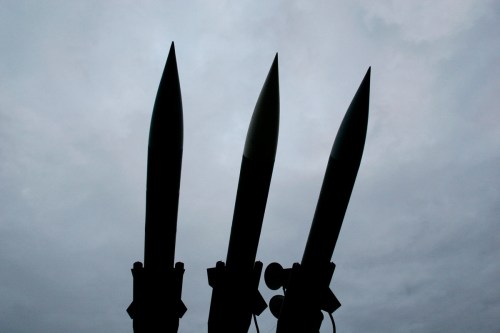
I thought these anti-aircraft missile launchers only existed in video games.
Even cooler than the tanks, though, were the running battles in the museum’s backyard. As part of the Museum Night festivities, reenactments of Russian military history up to World War II were staged in a large treed yard, dug through with trenches and strung with barbed wire.
Sadly, we were only able to watch the World War One reenactment, but it was plenty awesome. Spectators cheered as Russian soldiers charged out of the trenches, guns spitting fire, cutting down German soldiers.
After the Russians won the battle, kids quickly ran out onto the field, looking for spent casings and mingling with the soldiers. Everbody else soon joined, check out the trenches and hopping the barbed wire. With lawsuits and such, I’m adding this to my list of things that work a bit differently in America.
We walked around after that, mingling with fake Nazi soldiers, knights with swords and shield, and even mock American soldiers from World War II, speaking Russian and some hilariously broken English.
As I wrote about yesterday, we were planning on going to a bunch of museums as part of the Museum Night event. But, as you can probably tell, we spent a whole lot of time at the Artillery Museum.
This was not entirely by choice. We had planned to start the night at Dostoevsky’s house, a museum/tribute to the famous Russian writer. But although Dostoevsky’s house was participating in Museum Night, tickets to the event were not being sold there, a fact that wasn’t in any of the Museum Night stuff we had researched online.
So we went to a Russian pizza place, and then took the metro over to Petrogradsky Island, site of the Peter and Paul Fortress, Artillery Museum, and a bunch of other museums we had planned to visit.
But the metro stop right by all the museums, the one we had planned to get off at was ремонт, or under repair—which we discovered only as our train sped through the darkened station (My roommate Tom wrote about the significance of ремонт in Russia on his blog.). We got off at the next station, still on Petrogradsky Island, but a mile walk to the museums.
Luckily, getting off at that station earned me my first picture with Lenin, which pretty much made the walk worthwhile.

Me and Lenin. In Russia, people don't smile for pictures.
Posted in Russia
Tagged artillery, Artillery Museum, German, lenin, metro, missile, museum, Nazi, rocket, Soviet, St. Petersburg, tank, war, word war II
 Zachary Tracer