
Category Archives: Russia

Daniil Kharms and Stalin-era repression

A small memorial plaque for Russian writer Daniil Kharms.

A small memorial plaque for Russian writer Daniil Kharms.

The X in the Russian name of absurdist writer Dаниил Хармс is a bit more ambiguous than the transliterated Kh suggests. Kharms studied English and German at his prestigious high school, and it is believed that he adopted his pen-name not only for its similarity to “harms” and “charms,” but also because it sounded like the name of a certain famous English detective.

Indeed, Kharms always dressed like Sherlock Holmes—pipe, top hat, and silly pants—at a time in Soviet history when standing out was a risky move. Kharms also stood out for his writings, ranging from absurdist dramas and poems to children’s stories that strayed from approved socialist values and storylines.

For his unwillingness to conform, Kharms was first arrested in 1931 and briefly exiled. But Kharms continued his absurdist writing, falling afoul of those in the Stalinist system charged with maintaining uniformity and order.

The strange writer, living in poverty, was arrested again in 1941 (shortly after the German invasion of the USSR) on charges of being a German spy, and imprisoned in Leningrad.

What is known with certainty is that Kharms died soon after, in 1942. What is unknown is how. Some say he was executed. Other that he starved during the siege of Leningrad, or died when prisoners were packed into train cars without food or water and sent west ahead of the invading Nazis. Still others say he was tortured until he died.

We’re reading a few of Kharms’ stories in our literature class. The stories are unthreatening—Dr. Seuss and Shel Silverstein have written works far stranger. But neither of them lived in a society where being different could be a death sentence.

Since reading Kharms’ work and seeing the memorial plaque, I’ve visisted two sites that deal explicitly with Soviet history: Sergei Kirov’s apartment and the Museum of the Political History of Russia. And although the museums were interesting, I’m left feeling that in some way, Daniil Kharms’ memorial plaque is just as revealing as glass display cases filled with historical documents and faded images.

The Museum of Erotica

Forget about the title. For titillation, turn elsewhere. This post is actually about medical privacy.

Dr. Igor Knayzkin, the chief prostate researcher of the Russian Academy of Natural Sciences, runs a venereal disease, prostate, and general sexual health center in a light pink building on the edge of the Tauride Palace gardens.

Dr. Knayzkin’s clinic, however, also houses a small collection of erotica in glass cases in its white, medical hallways.

Enter the center, proceed past the first images of naked women, pay the receptionist—the same one that checks in patients—100 rubles ($3), and you’ll be given blue plastic covers to put over your shoes.

Slip the covers over your shoes, proceed past the patients in the waiting room, and enter the medical center hallways to examine the cases of sexual sculptures, phallic figurines, coffee mugs with balls, and the requisite Greek and African erotic art.

Make sure to stay out of the way of the white-coated attendants exiting exam rooms in the same hallway and the patients fresh from their various intimate appointments.

Russians, apparently, aren’t quite as fanatical about their medical privacy—HIPAA remains an American innovation.

But even if you are a bit embarrassed by camera touting tourists traipsing by as your testicles are examined, perhaps there’s good reason to go to Dr. Knayzin’s clinic. And that reason has nothing to do with the prominent doctor’s medical skill, or all the ads he has bought in the St. Petersburg metro.

You see, the medical center houses the embalmed 30 centimeter penis that allegedly once belonged to Grigori Rasputin, an incredibly odd character and close adviser to the last Tsar, Nicholas II.

Simply viewing the member is said to cure impotence (Warning: Link contains an image of said device). In any event, it’s a heck of a lot cheaper than any scientifically proven remedy.

Pravda, the newspaper of Russia’s Communist Party, covered the museum’s 2004 opening and scored an apparently-exclusive interview with a Rasputin descendant:

Rasputin’s great grandchild John Nekmerson is currently living in the US. He is a grandchild of Matrena Rasputina, Rasputin’s favorite daughter. After her father was murdered, she fled to Europe and afterwards migrated to America, where she began working as a tiger-tamer. She died in 1977. Recently, John Nekmerson has visited St. Petersburg in order to see his ancestor’s private part with his own eyes. The great grandson exclaimed, “This is really it, I’ve got the same one!”

Just a typical day

The Smolny Cathedral stands behind our school building.

The Smolny Cathedral stands behind our school building.

In a place where darkness does not come until nearly midnight, the beeping of my watch always wakes me far too early.

As 7:00 flashes on the face of my Timex, I roll over and hastily reset the alarm to 7:10, an improvised snooze button.

7:10 finds me rolling out of bed and plodding across the brown linoleum fake-tiled floors into the shower.

Water pressure is not a concern; Russia does not yet know the dubious pleasure of low flow. Water temperature is another matter. The water cascading out of the showerhead is easily set to scalding (and I do mean scalding, much hotter than any American shower), or freezing—Gulf of Finland cold. A comfortable temperature requires extraordinary finesse, difficult before the morning cup of black caffeine.

And fortunately, that dark boost comes soon enough. Russia lacks a strong black coffee tradition, so my morning drink has become Princess Noori High Grown Black Tea (25 bags for 20 rubles at Paterson, your local surly supermarket). Princess Noori is followed by an equally exotic treat—a banana, bought not from Paterson, where the produce is neither fresh nor appealing, but from the wealthy Russian grocery store, the one with food from everywhere except Russia itself.

When bananas-нет, it’s cheese and crackers for me. Paterson carries one brand of crackers; they come in a pink plastic pouch that loudly proclaims Крекер (Cracker) in bold type across the front. They’re not particularly good and they’re not particularly bad. Wheat Thins they are not.

Food eaten, it’s time to catch the bus to school. The coach bus, with pleasantly upholstered seats and white window shades that do little to block the glare of the morning sun as I try to steal some last minutes of shut eye, leaves at 8:30 each morning. Not 8:31. Not 8:30:05. 8:30.

The ride, a distance of no more than 10 miles, takes at least an hour in the vicious St. Petersburg traffic. The bus rarely makes it out of first gear, particularly in the пропка (propka – traffic jam) trying to cross the Leytenanta Shmidta Bridge.

Fortunately, the route wends along the Neva and through much of the historic city, past St. Isaac’s massive Cathedral, near the Bolshevik’s first battleship, the Aurora (framed now by billboards for beer and mobile phones), ending at the Smolny Cathedral, the centerpiece of the Smolny Institute of Saint Petersburg State University.

Incidentally, the beautiful Carolina blue cathedral is a major attraction (Never thought I’d use beautiful and Carolina blue in the same sentence). Walking to classes, we always pass busloads of camera-touting tourists, snapping photos of the big church, just as I’m used to at the Duke Chapel.

Once inside, we make our way down the wooden hallway to room 109, a narrow, high-ceilinged classroom with a large windows looking out on trees, a road, and beyond that, the Neva River.

Each day in that room, there are two classes taught by two professors. Each—literature, grammar, speaking, film, media, culture (pick two)—is an hour-and-a-half long. The names of the courses don’t really matter. They’re all stuffed with Russian grammar, vocabulary, and pronunciation lessons, whatever the title.

Each class tries my ability to sit still and focus, despite the fact that every piece of Russian I pick up is immediately useful, despite the tiny seven-person class, despite the skill of our professors, despite my interest in the material.

1:00 p.m.—the time when words learned in literature get used to buy fast food blini at Teremok—is always welcome when it comes.

Five Strange Things at the Supermarket

Paterson (Патерсон) is our 24/7 supermarket of choice in Russia. Now that I’ve gone shopping too many times, here are five Paterson oddities, or perhaps just general Russian supermarket oddities.

  1. Eggs come in boxes of ten. I always feel like I’m getting ripped off.
  2. Red caviar flavored Lays potato chips. Also: шашлик (shashlik—sort of shiskabob/Russian BBQ) flavored Lays.
  3. There are no granola bars. No chewy bars. No Clif bars. No cereal bars. No breakfast bars. No fruit-filled bars. No low-fat diet bars.
  4. Lots of mayonnaise. But no tomato sauce, damn it.
  5. Plastic bags cost 6 rubles. This is perhaps the most environmentally friendly feature of St. Petersburg (awesome subway system aside) that I have seen thus far.

Drink, Drank, Drunk

The verb drink is irregular in both English and Russian. In class today, we learned how to conjugate it. We also got a few Russian drinking tips, tailored to an American audience:

  1. Russians drink vodka like Italians drink espresso. Be careful!
  2. Russians drink their vodka straight. And quickly. Be careful!
  3. It’s important to have a big meal before drinking a lot of vodka. Be careful!
  4. If you don’t have time to eat a big meal, at least eat a piece of buttered bread. Be careful!

Alcohol in Russia is a bit more accessible than it is in America. There is a sign at the grocery story saying that it is forbidden to buy cigarettes if you are under 18. There is no such sign for alcohol.

And Russian kids appear to enjoy the relaxed rules. Groups of teenagers, probably no older than 16, gather on sidewalks, drinking from big cans of Nevskoe Ice, smoking and killing time. Public (and underage) drinking is technically illegal, but I haven’t seen the St. Petersburg police give anyone any trouble.

Kids aren’t the only ones who drink in public, though. Grown men often walk in the streets, a cool Baltika 7 (or again, Nevskoe Ice – It’s apparently pretty popular) in hand. Sadly, I haven’t taken part in this Russian tradition—quite frankly, the Militsia, as the leather-jacketed police are called, scare me more than a bit.

But there are plenty of options for drinking beyond the street corner.

Every restaurant, pizza place, fast food joint, and coffee shop has an alcohol selection bigger than some American liquor stores. You can get a cheap shot of Ruski Standard vodka or a several thousand ruble bottle of wine with whatever food happens to be available at your chosen dining establishment.

The alcohol selection at the corner grocery store is even more mind-boggling. There’s a full aisle of hard liquor, another of wine, and another of beer. There is also a locked cabinet for the really expensive stuff, and beer fridges placed strategically throughout the store for those who get thirsty while shopping.

Why my name sucks in Russian

My name sucks/is funny in Russian for two reasons:

  1. Zach sounds like зек, pronounced zek, which is a Russian slang term for prisoner. To avoid this problem, I’ve taken to pronouncing my name as Zaaaaak.
  2. Zachary sounds like закурить (zakooreet), which means “to start smoking.” I haven’t figured out a way to avoid this problem yet.

Slideshow: Artillery Museum

Missiles

Missiles

Click here to see photographs from the Artillery Museum in St. Petersburg.

Museum Night, Missiles, and Tanks

People eat next to a Soviet T-80 tank.

People eat next to a Soviet T-80 tank.

Tanks! Missiles! Cannons! Rockets and rocket launchers!

The Artillery Museum in St. Petersburg is billed as a great place to go to climb on and marvel at military equipment, and in this role, it definitely doesn’t disappoint. The place is full of fighting machines, from historical cannons to the RT-2PM Topol, a massive mobile intercontinental ballistic missile launcher, complete with (mock?) missile.

Kids, and more than a few adults, were climbing on the artillery pieces near the entrance and posing for pictures. Bunches of people walked around, checking out anti-aircraft guns, spinning Topol’s wheels, or watching a free concert set up in the middle of the outdoor museum for Museum Night.

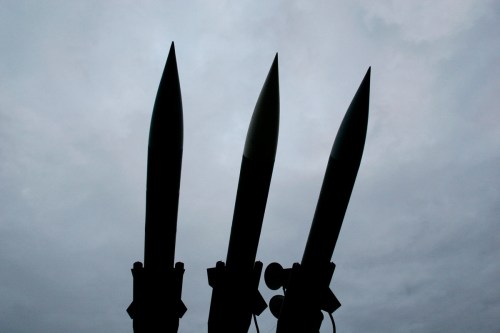
I thought these anti-aircraft missile launchers only existed in video games.

I thought these anti-aircraft missile launchers only existed in video games.

Even cooler than the tanks, though, were the running battles in the museum’s backyard. As part of the Museum Night festivities, reenactments of Russian military history up to World War II were staged in a large treed yard, dug through with trenches and strung with barbed wire.

Sadly, we were only able to watch the World War One reenactment, but it was plenty awesome. Spectators cheered as Russian soldiers charged out of the trenches, guns spitting fire, cutting down German soldiers.

After the Russians won the battle, kids quickly ran out onto the field, looking for spent casings and mingling with the soldiers. Everbody else soon joined, check out the trenches and hopping the barbed wire. With lawsuits and such, I’m adding this to my list of things that work a bit differently in America.

We walked around after that, mingling with fake Nazi soldiers, knights with swords and shield, and even mock American soldiers from World War II, speaking Russian and some hilariously broken English.

As I wrote about yesterday, we were planning on going to a bunch of museums as part of the Museum Night event. But, as you can probably tell, we spent a whole lot of time at the Artillery Museum.

This was not entirely by choice. We had planned to start the night at Dostoevsky’s house, a museum/tribute to the famous Russian writer. But although Dostoevsky’s house was participating in Museum Night, tickets to the event were not being sold there, a fact that wasn’t in any of the Museum Night stuff we had researched online.

So we went to a Russian pizza place, and then took the metro over to Petrogradsky Island, site of the Peter and Paul Fortress, Artillery Museum, and a bunch of other museums we had planned to visit.

But the metro stop right by all the museums, the one we had planned to get off at was ремонт, or under repair—which we discovered only as our train sped through the darkened station (My roommate Tom wrote about the significance of ремонт in Russia on his blog.). We got off at the next station, still on Petrogradsky Island, but a mile walk to the museums.

Luckily, getting off at that station earned me my first picture with Lenin, which pretty much made the walk worthwhile.


Me and Lenin. In Russia, people don't smile for pictures.

Me and Lenin. In Russia, people don't smile for pictures.

Gay Rights Parade Attacked, Protesters Arrested in Moscow

BBC reports:

Police in Russia have broken up a protest by gay rights activists in Moscow, staged to coincide with the final of the Eurovision Song Contest.

Some 30 campaigners had gathered near a university in defiance of a ban on their march and many were dragged away by police when they shouted slogans….

The Moscow mayor Yuri Luzkhov has described gay parades as “satanic”.

Anti-gay groups had threatened to take matters into their own hands if the police failed to stop the protest.

We watched OMON (Russian Special Forces) break up the protest and drag the protesters away on BBC, one of several English-language channels we get.

As you can tell, the attitude towards homosexuals in Russia isn’t exactly tolerant. I’ve seen a few lesbian couples on the street, but no gay couples. According to my guide book, St. Petersburg is more tolerant of homosexuality than other parts of Russia because it’s more European. I’m not really reading the Russian news here (I can’t, really), but I’ll let you know if I see anything in it about the protests.

The State Memorial Museum of the Defense and Blockade of Leningrad

A million Leningraders died during the 900 day siege of the city during the Second Great Patriotic War. Some starved, some froze, and some were killed by German guns and bombs.

The siege plays a heavy role in the city’s collective memory. I’ve already written about Victory Day, but beyond that single day, memorials to the dead and reminders of the city’s heroic sacrifice are everywhere. Incidentally, there was even one on the wall of the movie theater we went to after we left the State Memorial Museum of the Defense and Blockade of Leningrad.

The museum itself is contained in a plain building, across a canal from the flashier parts of Petersburg. The exhibits—old Soviet and Nazi German uniforms, maps, guns, photos, letters, and lots of other items—line the walls of a single large warehouse room. Massive paintings of battle scenes and Soviet leaders sit higher on the walls, above the exhibit cases, framed by large gray curtains.

I was amazed by the sheer concentration of World War II stuff in the museum, although I couldn’t read most of it. There were photos of the Soviet leaders I’ve read so much about, including a particularly cool one of Gen. Eisenhower and Georgy Zhukov, a Soviet Marshall who led the Red Army to Berlin.

There were also plenty of weapons, from AK machine guns to partisan bolt-action rifles—and even an anti-tank gun—and a bunch of bombs and mines. As for uniforms, there were some Soviet ones (from what I could tell, they had belonged to Heroes of the Soviet Union) filled with medals and ribbons, as well as some Nazi ones, including SS uniforms with lightning bolts and Totenkopf, or Death’s Head skulls.

Between the military paraphernalia, there was a reconstructed blockade-era apartment flanked by photos of people living day-to-day, looking just slightly healthier than concentration camp survivors. The only sound was the ticking of a metronome on the radio—the beating heart of Leningrad.

There was also propaganda… Lots and lots of propaganda. I gotta say, I loved it. I mean, who doesn’t love Nazi soldiers portrayed as either evil or incredibly stupid? The great thing about propaganda, too, is that it’s mostly visual. So while we couldn’t figure out most of the words, the meaning got through (It helps that the word for fascist is pretty much the same in Russian).

One that was particularly amusing involved three panels:

  1. Nazis reading a complicated list of orders.
  2. Nazis marching with a full band.
  3. Soviet soldiers popping up, surprising the Nazis, and wiping them out. (The caption was something along the lines of “Our orders are simple. Kill the fascist occupiers.”

We’re planning to go back and get an English-language tour of the museum at some point so that we actually understand what’s going on a bit more.

Tonight is Museum Night in St. Petersburg. 150 Rubles to get into a ton of museums around the city—and the museums are open from 6 p.m. to 6 a.m. There are buses running between the museums all night, but we need to be back on our island before the bridges go up around 1:30 a.m.

We’re planning on checking out the Peter and Paul Fortress, the Artillery Museum, where you can apparently climb on tanks and artillery and such, the Museum of the Political History of Russia (and the attached, and closely connected Museum of the History of the Political Police. Seriously.), and several others.

Also – Kirov’s apartment. The assassination of Sergey Kirov in 1934 (incidentally in the Smolny Institute, where we go to school every day) helped start Stalin’s purges.