Category Archives: Russia

Why dodge the Russian draft?

After yesterday’s post on police checking ID to find draft-dodgers, I want to add a bit of context as to why young men try so hard to stay out of the Russian military.

In a word, it comes down to hazing. I’m no expert on hazing in the Russian armed forces, but here is what I do know:

  • In 2004, at least 44 (Government figure), and as many as 3,000 (human rights group estimate) Russian draftees were killed in hazing incidents or commited suicide as a result of hazing. (Source: Pravda)
  • In the same year, Human Rights Watch released a report on hazing in the Russian military, and called on the government to do more to stop it. HRW estimated that hazing caused the “deaths of dozens of conscripts every year, and serious—and often permanent—damage to the physical and mental health of thousands others. Hundreds of conscripts commit or attempt suicide each year, and thousands run away from their units.”
  • In 2006, Private Andrei Sychyov was beaten so badly that his legs and genitals had to be amputated. His case was one of the few to be publicly discussed in Russia, because the doctors treating him leaked information to the media. (Sources: Radio Free Europe, NPR)
  • After Sychyov’s case became public, news outlets discovered another case at least as disturbing.
  • The St. Petersburg Times reported on the humiliation, beating, extortion and other trials Russian conscripts face following the Sychyov case. Despite the testimony of a hazed soldier, Russia’s Defense Minister dismissed continuing concerns about hazing.

Documents, please

Every time I walk past a police officer in St. Petersburg, I look down, up, to the side—anywhere but his face. It’s not that I’m guilty of anything, but here the militsia, as the St. Petersburg police are called, are not known for jolly attitudes and community outreach. They also do not need a reason to ask for your documents, an open request that can lead to questioning in an unfamiliar language and to the gifting of pastel-colored Ruble notes.

I’ve played out the scenario many times in my mind: An officer’s eye meets mine. Nightstick dangling from his wrist—Russian police seem to always have their nightsticks out and ready—he approaches. As I pull my photocopied passport (And here’s the technical guilt: By law, one is required to have the actual passport with him at all times) out of my wallet, he sizes up its monetary contents. He questions me. I tell him—in English—that I speak no Russian, as I’ve been advised to do. He suggests a ruble figure. I comply, replacing my passport in my now-lighter wallet, walking away, if all goes well.

Today, my imagination met reality.

As I walked into Vaselostravskaya Metro Station, a police officer, standing to the side with two others, stopped me. “Документы, пожалуйста,” documents please. As I’d practiced, I told him that I speak no Russian as I unfolded the crumpled copy of my passport. “Ah, American,” he said. And smiled. One of his partners added in a “Hello, American.” The young officer, no club in hand, gave me back my passport, and I was on my way.

Apparently, the police are not looking to bother American students, or to earn an easy several-hundred rubles.

According to the St. Petersburg Times, what the police are looking for is draft dodgers—young men trying to escape their mandatory time in Russia’s military. Spring is draft time, so the police may (they deny this, according to the St. Petersburg Times) be ratcheting up efforts to fill the military’s ranks, in part by checking the documents of young men at metro stations.

Taste Test: Red Caviar Lays

Red Caviar Lays

Red Caviar Lays

When you open a bag of Red caviar flavored Lays potato chips, the fish aroma is absolutely unmistakble. In fact, the scent of fish emanating from potato chips is a bit odd, a bit disturbing, and perhaps, a bit scary.

The chips taste like they’re supposed to. Which is to say that they taste like fried potatos, salt, and caviar. But the chips lack the distinctly slimey and chewy texture of fish eggs, which one expects from the taste. All in all, a disorienting experience. And unfortunately, the bag remains unfinished—hoping my room mates will want some.

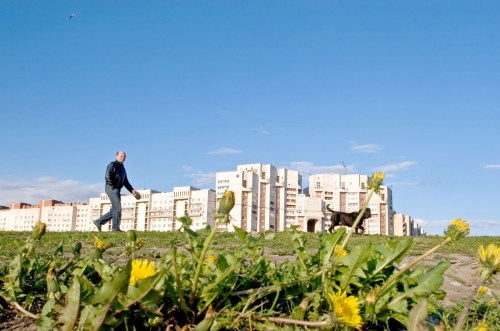
Photo: Walking a Dog

A man walks his dog in a strip of grass adjacent to the Gulf of Finland.

A man walks his dog in a strip of grass adjacent to the Gulf of Finland.

Russia tries to control interpretations of its past

For the Soviet Union, history was always a touchy subject. The state derived its legitimacy, at least in part, from a historical narrative that portrayed the Bolshevik revolutionaries as embodying the aspirations of the vast majority of Russians—not as a minority imposing their will through violence.

The Soviet Union couldn’t even stomach criticism that avoided the state’s founding myths. Soviet historian Roy Medvedev was harassed and expelled from the Communist party in the late 1960’s for writing a book critical of Stalin, for instance. There was one acceptable version of history—the one that suited the interests of the state.

And now, it seems the Russian government is working to shape the past once again. The St. Petersburg Times reports Russian President Dmitri Medvedev is creating a committee charged with “collecting and analyzing information about attempts to diminish Russia’s prestige by falsifying history.”

The initiative may simply be a piece in formulating a broader, more coherent national approach to Soviet-era history, particularly the Stalin era (sort of a curriculum standardization). Or it may be a political move, with little real effect. Of course, it could also have real consequences for the study of history in Russia.

Analysts quoted by the St. Petersburg Times seemed to have differing opinions. One believes that the committee may open more archives to researchers, making it beneficial in the long run. Another analyst, however, said the committee might lead to, “defense of the historical myth about Russia in the interests of the country’s rulers.”

Among Russians, memories of the Communist era are mixed.

While the horror of Stalin’s reign is acknowledged, there are still mixed feelings towards him here. Stalin embarked on massive purges and collectivized agriculture, killing millions, but also pursued large-scale industrialization and defeated the Nazis.

The text at the Museum of the Political History of Russia in St. Petersburg—a glimpse into how the state wishes to present its past—is quite critical of Stalin and his purges. But it does not mention some of the most undeniably evil portions of his reign. The Holodomor famine that occurred in the early 1930s in Ukraine, killing millions, is absent. Stalin’s aggressive collectivization of agriculture led to the famine, and Ukrainians consider the famine to be a genocide committed against their people. Russia rejects this claim.

In a related development, Russia’s parliament is likely to pass a bill that would criminalize criticism of the actions of the Red Army during World War II, the St. Petersburg Times reported. Penalties for such criticism, which is often made in former Soviet republics, could reach five years in prison. Foreigners who accuse the Red Army of atrocities (See: Katyn Massacre and Soviet War Crimes) could be punished upon entering Russia.

For a slightly different view of Medvedev’s committee, let’s turn to Pravda, the newspaper of Russia’s communist party. In a translated article headlined Russia will never let anyone falsify history of Second World War, Pravda celebrates the government’s effort to combat portrayals of Soviet soldiers as looters and rapists.

“As a matter of fact, we find ourselves in the situation when we must defend the historic truth and even prove the facts that seemed to be absolutely obvious not so long ago. It can be very hard and even disgusting at times, but we must do it. We must not turn a blind eye on the terrible truth of the war. We will never let anyone cast doubt on the deeds of our nation,” Medvedev said, according to the paper.

Neither Pravda nor the St. Petersburg Times made it clear exactly which “correct” version of history the government will promote.

The Saint Petersburg Mosque

The Saint Petersburg Mosque

The Saint Petersburg Mosque

The St. Petersburg Mosque, when it was completed in the waning days of the last Tsar, could hold many of St. Petersburg’s 8,000 Muslims. The massive mosque stands tall near the Neva River, not far from the Peter and Paul Fortress and other central St. Petersburg landmarks.

That the mosque survived the Bolshevik Revolution and the siege of Leningrad is incredible. However, the beautiful building was used as a warehouse starting in the 1940’s, and was only allowed to again function as a mosque at the request of Indonesia’s president in 1956. The mosque continues to serve St. Petersburg Muslims to this day, and the interior of the building is open only to members

The American Embassy

We went to the American Embassy in St. Petersburg today.

It has golden arches and serves Биг Мак and гамбургер (That’s Big Macs and hamburgers).

Seriously though, the McDonalds menu is almost identical in Russia—all the food items are transliterated in Cyrillic, even my филет-о-фиш (fillet-o-fish), and there really isn’t anything uniquely Russian.

The McFlurrys (Макфлурри), though, do come in different flavors: chocolate-caramel and chocolate-cherry. I tried chocolate-cherry. It did not disappoint.

The restaurant itself, across from Pushkinskaya Metro Station, is rather upscale by American McDonalds’ standards.

It boasts free Wi-Fi, and dinner time saw a crowd of well-dressed Russians besiege the cashiers (lines work a bit differently here), while others, mostly student-looking types, sat on brown faux(?)-leather stools and chairs and pecked away at laptops perched on bright white tables.

Country music played in the background as families enjoyed their fast food, wrapped in packages identical to their American counterparts, except for the Cyrillic script.

Even the friendly McDonalds atmosphere seemed to infect the joint, to a point—the cashier smiled as I fumbled the Russian words for chocolate-cherry, and thanked me after I had paid for my ice-cream drink and fish sandwich, in English!

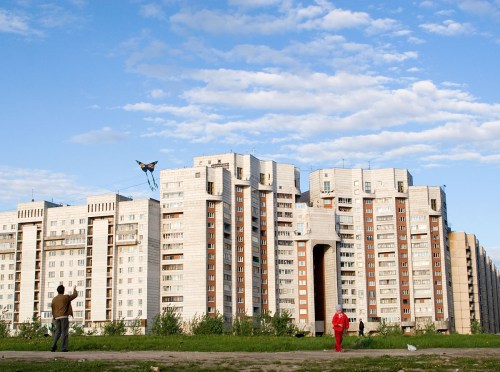
Flying a Kite by the Gulf

A man flies a kite near the Gulf of Finland.

A man flies a kite near the Gulf of Finland.

Photos from The Hermitage


The Winter Palace, also called The Hermitage, houses a huge number of pieces of Western art. In front of the palace is Palace Square, site of the 1905 Bloody Sunday Massacre.

The Winter Palace, also called The Hermitage, houses a huge number of pieces of Western art. In front of the palace is Palace Square, site of the 1905 Bloody Sunday Massacre.

The Winter Palace, or Hermitage, now houses a massive collection of European art. Prior to 1917, it was the official residence of the Russian Tsar. It was also the site of the provisional government following the Tsar’s overthrow, and was stormed and ransacked during the Bolshevik Revolution.

Click here to see a few photographs from inside The Winter Palace.

A Curious Sign

I'm not sure what this sign is warning about, but it doesn't look good.

I'm not sure what this sign is warning of, but it doesn't look good.

Any guesses as to what this sign might be warning about?