
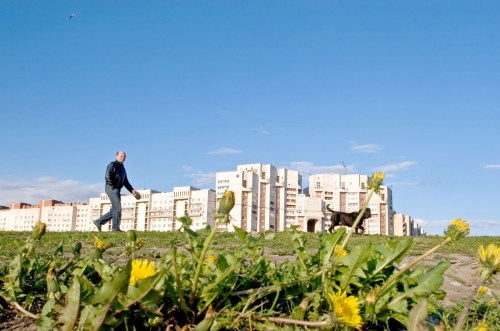
A man walks his dog in a strip of grass adjacent to the Gulf of Finland.
A man walks his dog in a strip of grass adjacent to the Gulf of Finland.
Tagged dog, gulf of finland, nature, photo, St. Petersburg
For the Soviet Union, history was always a touchy subject. The state derived its legitimacy, at least in part, from a historical narrative that portrayed the Bolshevik revolutionaries as embodying the aspirations of the vast majority of Russians—not as a minority imposing their will through violence.
The Soviet Union couldn’t even stomach criticism that avoided the state’s founding myths. Soviet historian Roy Medvedev was harassed and expelled from the Communist party in the late 1960’s for writing a book critical of Stalin, for instance. There was one acceptable version of history—the one that suited the interests of the state.
And now, it seems the Russian government is working to shape the past once again. The St. Petersburg Times reports Russian President Dmitri Medvedev is creating a committee charged with “collecting and analyzing information about attempts to diminish Russia’s prestige by falsifying history.”
The initiative may simply be a piece in formulating a broader, more coherent national approach to Soviet-era history, particularly the Stalin era (sort of a curriculum standardization). Or it may be a political move, with little real effect. Of course, it could also have real consequences for the study of history in Russia.
Analysts quoted by the St. Petersburg Times seemed to have differing opinions. One believes that the committee may open more archives to researchers, making it beneficial in the long run. Another analyst, however, said the committee might lead to, “defense of the historical myth about Russia in the interests of the country’s rulers.”
Among Russians, memories of the Communist era are mixed.
While the horror of Stalin’s reign is acknowledged, there are still mixed feelings towards him here. Stalin embarked on massive purges and collectivized agriculture, killing millions, but also pursued large-scale industrialization and defeated the Nazis.
The text at the Museum of the Political History of Russia in St. Petersburg—a glimpse into how the state wishes to present its past—is quite critical of Stalin and his purges. But it does not mention some of the most undeniably evil portions of his reign. The Holodomor famine that occurred in the early 1930s in Ukraine, killing millions, is absent. Stalin’s aggressive collectivization of agriculture led to the famine, and Ukrainians consider the famine to be a genocide committed against their people. Russia rejects this claim.
In a related development, Russia’s parliament is likely to pass a bill that would criminalize criticism of the actions of the Red Army during World War II, the St. Petersburg Times reported. Penalties for such criticism, which is often made in former Soviet republics, could reach five years in prison. Foreigners who accuse the Red Army of atrocities (See: Katyn Massacre and Soviet War Crimes) could be punished upon entering Russia.
For a slightly different view of Medvedev’s committee, let’s turn to Pravda, the newspaper of Russia’s communist party. In a translated article headlined Russia will never let anyone falsify history of Second World War, Pravda celebrates the government’s effort to combat portrayals of Soviet soldiers as looters and rapists.
“As a matter of fact, we find ourselves in the situation when we must defend the historic truth and even prove the facts that seemed to be absolutely obvious not so long ago. It can be very hard and even disgusting at times, but we must do it. We must not turn a blind eye on the terrible truth of the war. We will never let anyone cast doubt on the deeds of our nation,” Medvedev said, according to the paper.
Neither Pravda nor the St. Petersburg Times made it clear exactly which “correct” version of history the government will promote.
Posted in Russia
Tagged Bolshevik, historiography, history, Katyn, lenin, Medvedev, Nazi, Poland, pravda, propaganda, Red Army, Roy Medvedev, Russia, Soviet, St. Petersburg Times, stalin, world war II

The Saint Petersburg Mosque
The St. Petersburg Mosque, when it was completed in the waning days of the last Tsar, could hold many of St. Petersburg’s 8,000 Muslims. The massive mosque stands tall near the Neva River, not far from the Peter and Paul Fortress and other central St. Petersburg landmarks.
That the mosque survived the Bolshevik Revolution and the siege of Leningrad is incredible. However, the beautiful building was used as a warehouse starting in the 1940’s, and was only allowed to again function as a mosque at the request of Indonesia’s president in 1956. The mosque continues to serve St. Petersburg Muslims to this day, and the interior of the building is open only to members
Posted in Russia
Tagged bolshevilk, Culture, mosque, muslim, Neva, photo, siege, St. Petersburg
We went to the American Embassy in St. Petersburg today.
It has golden arches and serves Биг Мак and гамбургер (That’s Big Macs and hamburgers).
Seriously though, the McDonalds menu is almost identical in Russia—all the food items are transliterated in Cyrillic, even my филет-о-фиш (fillet-o-fish), and there really isn’t anything uniquely Russian.
The McFlurrys (Макфлурри), though, do come in different flavors: chocolate-caramel and chocolate-cherry. I tried chocolate-cherry. It did not disappoint.
The restaurant itself, across from Pushkinskaya Metro Station, is rather upscale by American McDonalds’ standards.
It boasts free Wi-Fi, and dinner time saw a crowd of well-dressed Russians besiege the cashiers (lines work a bit differently here), while others, mostly student-looking types, sat on brown faux(?)-leather stools and chairs and pecked away at laptops perched on bright white tables.
Country music played in the background as families enjoyed their fast food, wrapped in packages identical to their American counterparts, except for the Cyrillic script.
Even the friendly McDonalds atmosphere seemed to infect the joint, to a point—the cashier smiled as I fumbled the Russian words for chocolate-cherry, and thanked me after I had paid for my ice-cream drink and fish sandwich, in English!
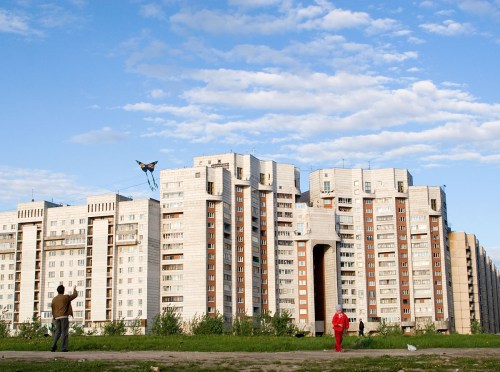
A man flies a kite near the Gulf of Finland.

The Winter Palace, also called The Hermitage, houses a huge number of pieces of Western art. In front of the palace is Palace Square, site of the 1905 Bloody Sunday Massacre.
The Winter Palace, or Hermitage, now houses a massive collection of European art. Prior to 1917, it was the official residence of the Russian Tsar. It was also the site of the provisional government following the Tsar’s overthrow, and was stormed and ransacked during the Bolshevik Revolution.
Click here to see a few photographs from inside The Winter Palace.
Tagged art, Bolshevik, Hermitage, museum, St. Petersburg, tsar, Winter Palace

I'm not sure what this sign is warning of, but it doesn't look good.
Any guesses as to what this sign might be warning about?

A small memorial plaque for Russian writer Daniil Kharms.
The X in the Russian name of absurdist writer Dаниил Хармс is a bit more ambiguous than the transliterated Kh suggests. Kharms studied English and German at his prestigious high school, and it is believed that he adopted his pen-name not only for its similarity to “harms” and “charms,” but also because it sounded like the name of a certain famous English detective.
Indeed, Kharms always dressed like Sherlock Holmes—pipe, top hat, and silly pants—at a time in Soviet history when standing out was a risky move. Kharms also stood out for his writings, ranging from absurdist dramas and poems to children’s stories that strayed from approved socialist values and storylines.
For his unwillingness to conform, Kharms was first arrested in 1931 and briefly exiled. But Kharms continued his absurdist writing, falling afoul of those in the Stalinist system charged with maintaining uniformity and order.
The strange writer, living in poverty, was arrested again in 1941 (shortly after the German invasion of the USSR) on charges of being a German spy, and imprisoned in Leningrad.
What is known with certainty is that Kharms died soon after, in 1942. What is unknown is how. Some say he was executed. Other that he starved during the siege of Leningrad, or died when prisoners were packed into train cars without food or water and sent west ahead of the invading Nazis. Still others say he was tortured until he died.
We’re reading a few of Kharms’ stories in our literature class. The stories are unthreatening—Dr. Seuss and Shel Silverstein have written works far stranger. But neither of them lived in a society where being different could be a death sentence.
Since reading Kharms’ work and seeing the memorial plaque, I’ve visisted two sites that deal explicitly with Soviet history: Sergei Kirov’s apartment and the Museum of the Political History of Russia. And although the museums were interesting, I’m left feeling that in some way, Daniil Kharms’ memorial plaque is just as revealing as glass display cases filled with historical documents and faded images.
Forget about the title. For titillation, turn elsewhere. This post is actually about medical privacy.
Dr. Igor Knayzkin, the chief prostate researcher of the Russian Academy of Natural Sciences, runs a venereal disease, prostate, and general sexual health center in a light pink building on the edge of the Tauride Palace gardens.
Dr. Knayzkin’s clinic, however, also houses a small collection of erotica in glass cases in its white, medical hallways.
Enter the center, proceed past the first images of naked women, pay the receptionist—the same one that checks in patients—100 rubles ($3), and you’ll be given blue plastic covers to put over your shoes.
Slip the covers over your shoes, proceed past the patients in the waiting room, and enter the medical center hallways to examine the cases of sexual sculptures, phallic figurines, coffee mugs with balls, and the requisite Greek and African erotic art.
Make sure to stay out of the way of the white-coated attendants exiting exam rooms in the same hallway and the patients fresh from their various intimate appointments.
Russians, apparently, aren’t quite as fanatical about their medical privacy—HIPAA remains an American innovation.
But even if you are a bit embarrassed by camera touting tourists traipsing by as your testicles are examined, perhaps there’s good reason to go to Dr. Knayzin’s clinic. And that reason has nothing to do with the prominent doctor’s medical skill, or all the ads he has bought in the St. Petersburg metro.
You see, the medical center houses the embalmed 30 centimeter penis that allegedly once belonged to Grigori Rasputin, an incredibly odd character and close adviser to the last Tsar, Nicholas II.
Simply viewing the member is said to cure impotence (Warning: Link contains an image of said device). In any event, it’s a heck of a lot cheaper than any scientifically proven remedy.
—
Pravda, the newspaper of Russia’s Communist Party, covered the museum’s 2004 opening and scored an apparently-exclusive interview with a Rasputin descendant:
Rasputin’s great grandchild John Nekmerson is currently living in the US. He is a grandchild of Matrena Rasputina, Rasputin’s favorite daughter. After her father was murdered, she fled to Europe and afterwards migrated to America, where she began working as a tiger-tamer. She died in 1977. Recently, John Nekmerson has visited St. Petersburg in order to see his ancestor’s private part with his own eyes. The great grandson exclaimed, “This is really it, I’ve got the same one!”
Posted in Russia
Tagged Culture, Igor Knayzin, Knayzkin, museum, museum of erotica, pravda, privacy, rasputin, Russian Academy of Natural Sciences, sexual health, St. Petersburg, tsar

The Smolny Cathedral stands behind our school building.
In a place where darkness does not come until nearly midnight, the beeping of my watch always wakes me far too early.
As 7:00 flashes on the face of my Timex, I roll over and hastily reset the alarm to 7:10, an improvised snooze button.
7:10 finds me rolling out of bed and plodding across the brown linoleum fake-tiled floors into the shower.
Water pressure is not a concern; Russia does not yet know the dubious pleasure of low flow. Water temperature is another matter. The water cascading out of the showerhead is easily set to scalding (and I do mean scalding, much hotter than any American shower), or freezing—Gulf of Finland cold. A comfortable temperature requires extraordinary finesse, difficult before the morning cup of black caffeine.
And fortunately, that dark boost comes soon enough. Russia lacks a strong black coffee tradition, so my morning drink has become Princess Noori High Grown Black Tea (25 bags for 20 rubles at Paterson, your local surly supermarket). Princess Noori is followed by an equally exotic treat—a banana, bought not from Paterson, where the produce is neither fresh nor appealing, but from the wealthy Russian grocery store, the one with food from everywhere except Russia itself.
When bananas-нет, it’s cheese and crackers for me. Paterson carries one brand of crackers; they come in a pink plastic pouch that loudly proclaims Крекер (Cracker) in bold type across the front. They’re not particularly good and they’re not particularly bad. Wheat Thins they are not.
Food eaten, it’s time to catch the bus to school. The coach bus, with pleasantly upholstered seats and white window shades that do little to block the glare of the morning sun as I try to steal some last minutes of shut eye, leaves at 8:30 each morning. Not 8:31. Not 8:30:05. 8:30.
The ride, a distance of no more than 10 miles, takes at least an hour in the vicious St. Petersburg traffic. The bus rarely makes it out of first gear, particularly in the пропка (propka – traffic jam) trying to cross the Leytenanta Shmidta Bridge.
Fortunately, the route wends along the Neva and through much of the historic city, past St. Isaac’s massive Cathedral, near the Bolshevik’s first battleship, the Aurora (framed now by billboards for beer and mobile phones), ending at the Smolny Cathedral, the centerpiece of the Smolny Institute of Saint Petersburg State University.
Incidentally, the beautiful Carolina blue cathedral is a major attraction (Never thought I’d use beautiful and Carolina blue in the same sentence). Walking to classes, we always pass busloads of camera-touting tourists, snapping photos of the big church, just as I’m used to at the Duke Chapel.
Once inside, we make our way down the wooden hallway to room 109, a narrow, high-ceilinged classroom with a large windows looking out on trees, a road, and beyond that, the Neva River.
Each day in that room, there are two classes taught by two professors. Each—literature, grammar, speaking, film, media, culture (pick two)—is an hour-and-a-half long. The names of the courses don’t really matter. They’re all stuffed with Russian grammar, vocabulary, and pronunciation lessons, whatever the title.
Each class tries my ability to sit still and focus, despite the fact that every piece of Russian I pick up is immediately useful, despite the tiny seven-person class, despite the skill of our professors, despite my interest in the material.
1:00 p.m.—the time when words learned in literature get used to buy fast food blini at Teremok—is always welcome when it comes.
 Zachary Tracer